Get Full Government Meeting Transcripts, Videos, & Alerts Forever!
Get email alerts on the Bart Cleaning Outreach topic
No spam. Unsubscribe anytime.
Supervisors and BART tout stepped-up cleaning, outreach at Sixteenth Street Mission plaza
Summary
Supervisors praised new BART cleaning routines and local outreach after months of overcrowding, discarded needles and human waste at the Sixteenth Street Mission BART Plaza; BART said it has reallocated staff, added dedicated shifts and plans an April deep clean and plaza sealing. Community speakers urged services and warned against policing-driven responses.
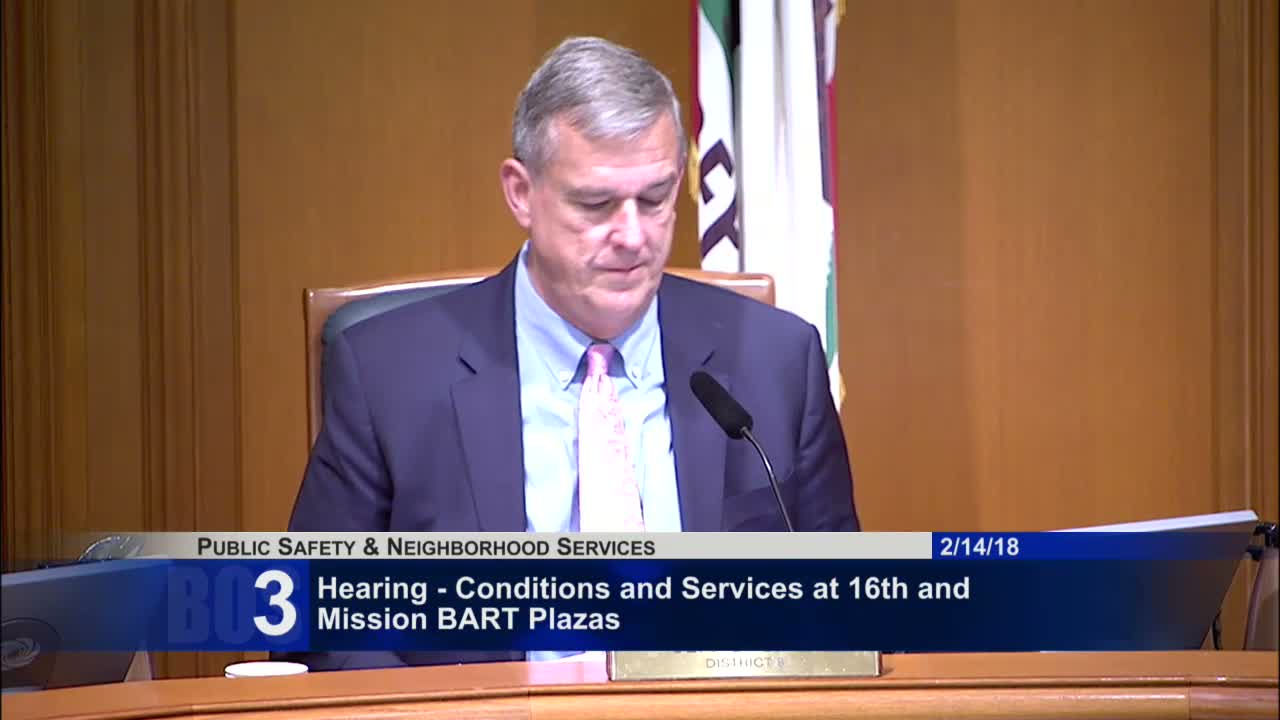
Supervisor Jeff Sheehy opened a February committee hearing on conditions at the Sixteenth Street Mission BART Plaza, where supervisors and BART officials described a stepped-up mix of cleaning, outreach and cross-agency coordination to address public health and safety concerns.
Supervisor Hillary Ronan, who helped organize weekly cleanups at the plaza with BART Director Bevan Dufty, told the committee she and Dufty had found ‘‘used needles, human waste, the stench of urine’’ and other hazards and said the neighborhood needed a stronger mix of social services and staffing at the station. Ronan said she and Dufty have been cleaning the site weekly and called for permanent HOT (Homeless Outreach and Treatment) team staffing at the station.
Paul Overseer of BART described a systemwide push to professionalize station cleaning that the agency says will directly affect Sixteenth and Mission. BART moved its cleaning workforce into maintenance management, hired dedicated supervisors and trainers, and adopted new standard operating procedures and KPIs. Overseer said the station now has dedicated coverage for all 14 weekly shifts and that six of those shifts will have two cleaners. BART also expanded nightly patio steam-cleaning from one hour to four hours, seven nights a week, and plans an intensive deep cleaning and plaza sealing in April to improve long-term effectiveness.
BART tied the work to rider experience and ridership trends, saying customer complaints and perceptions of cleanliness were partly behind a leveling-off in riders and that improving station conditions is a priority. Overseer said the April timeline is contingent on labor and procurement steps but called it a ‘‘pretty firm date.”
City Department of Public Works Deputy Director Larry Stringer described complementary street-level work: power washing, corridor workers who focus on the blocks around the station, two ‘‘pit stop’’ public restrooms co-funded with BART, and frequent graffiti removal. DPW staff said staffing limits currently prevent seven-days-a-week street coverage across all adjacent blocks and noted they are testing interventions such as a so-called "P-wall" to deter public urination.
Bevan Dufty, a BART board director who has participated in the cleanups, and BART staff emphasized coordination with SFPD, SFMTA and city agencies and described joint patrols and an elevator-attendant pilot at Civic Center. Dufty said the agency is pursuing a multi-jurisdictional approach because problems at some end-of-line stations reflect regional patterns of homelessness and demand on emergency services.
At least a dozen community speakers praised the cleanup work and outreach while warning against responses that prioritize policing or displacement over services. Speakers from neighborhood groups, Mission SRO tenants and nonprofit providers urged more bathrooms, navigation centers, HOTT staffing, and deeply affordable housing — and criticized delays in service delivery and the risk that cleanup efforts could become a pretext for gentrification.
Supervisor Ronan thanked community volunteers, downtown-streets teams and local contractors who have aided the cleanup. The committee filed the hearing for the record; no formal regulatory changes were voted at the hearing itself. The committee heard related items on law-enforcement-assisted diversion and navigation-center operations during the same meeting and referred follow-up questions on staffing and metrics to city departments.
Next steps: BART expects to implement the staffing and expanded steam-cleaning changes by April, pending labor discussions and procurement; city staff will continue coordination through the unified-command model and report back on specific metrics and neighborhood impacts.