Get Full Government Meeting Transcripts, Videos, & Alerts Forever!
Get email alerts on the Pge Explosion topic
No spam. Unsubscribe anytime.
PG&E outlines response to Mission Street gas explosion as supervisors press utility on detection and shut‑off delays
Summary
PG&E told a Board committee its crews shut off gas flow after a Nov. 27 Mission Street explosion and engaged Exponent for a cause investigation; supervisors and residents pressed the utility on why alarms did not alert the company sooner and why crews needed hours to stop the leak.
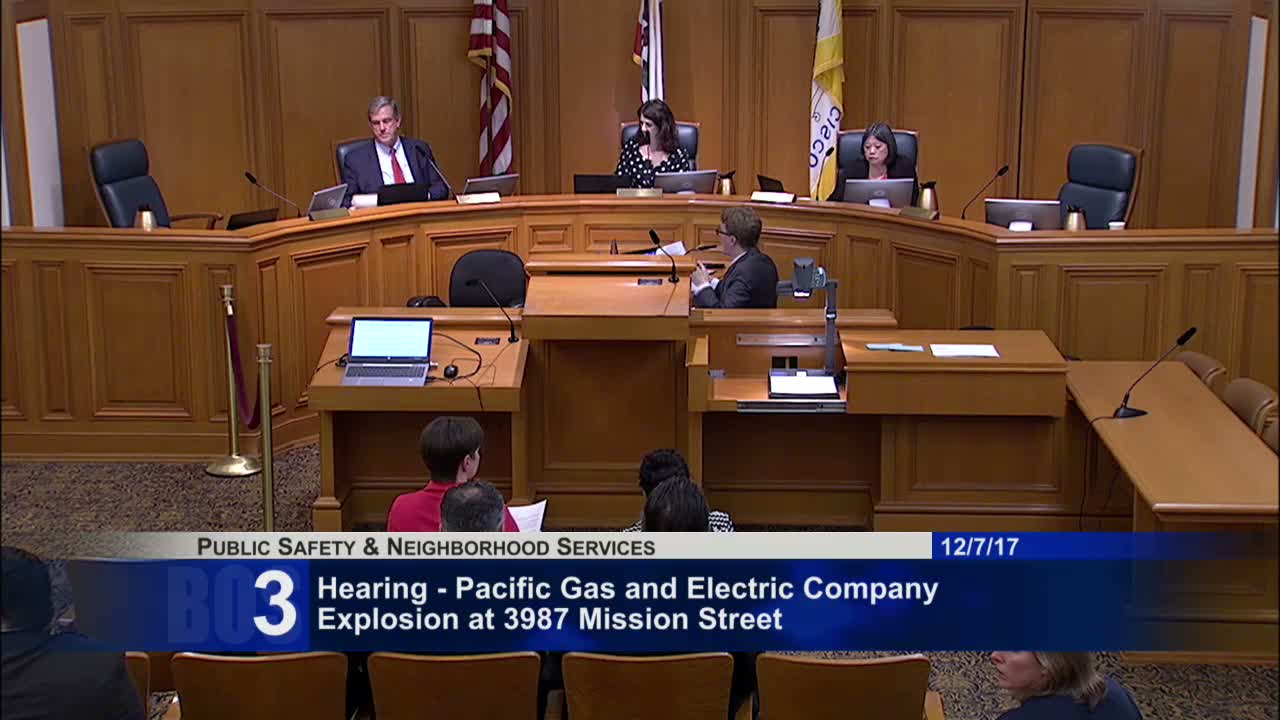
City officials and PG&E representatives met Dec. 7 to review the Nov. 27 gas‑line explosion at 3987 Mission Street and the company’s response.
Chair Hillary Ronan opened by saying her main concern was for affected residents and that the committee would seek accountability: “My foremost concern is for my constituents… I need to know that they are taken care of and that their losses are being covered,” she said.
PG&E representatives Ramik Saini and Christine (senior director of gas asset management and system operations) described the field response. Christine told the committee that crews arrived between about 10:20 and 10:35 a.m., found a high concentration of gas and implemented a larger isolation strategy because crews could not safely access the immediate leak site. "When our crews arrived, there was a high concentration of gas in the area," she said; PG&E said it stopped the flow of gas at about 12:50 p.m., temporarily impacted roughly 470 customers and called in Exponent Failure Analysis Associates to investigate the cause. PG&E also said it notified the California Public Utilities Commission (CPUC) and coordinated assistance with city agencies, the Red Cross and its own customer‑care teams.
Supervisors questioned why PG&E’s control‑center alarms did not trigger before the explosion and why the company used excavation and "squeeze" procedures rather than valves to isolate the leak. PG&E said in some configurations the pipeline network requires alternative isolation strategies and that the control‑center pressure alarms did not indicate the event before it was reported by the public and fire dispatch.
City emergency agencies described coordinated response and notification. The Department of Emergency Management said Alert SF reached more than 8,200 contacts in the immediate area and deployed a field incident management team and an evacuation center at the Mission YMCA. The Fire Department detailed evacuation perimeters and confirmed PG&E reported stopping gas flow late that afternoon; the Police Department described perimeter and evacuation assistance and underscored challenges reaching people with disabilities.
PG&E and city agencies said displaced tenants received temporary housing and financial assistance; the Human Services Agency described working with PG&E and the Red Cross to place displaced families together in nearby units. Residents and neighbors urged additional pipeline planning and safety review for transmission lines in Bernal Heights and other neighborhoods.
The committee continued the item to the call of the chair so PG&E’s investigation (the company estimated one to two months for Exponent’s report) and follow‑up questions about system design, notification and shut‑off practices can be examined in a subsequent session.