Get Full Government Meeting Transcripts, Videos, & Alerts Forever!
Get email alerts on the Police Budget topic
No spam. Unsubscribe anytime.
SFPD tells supervisors extra cuts could mean hundreds of job losses as DROP, academy costs and civilianization debated
Summary
San Francisco Police Department officials told the Board's Budget and Finance Committee that a second 10% contingency could force as many as 171 layoffs and that continuing the DROP retirement program is unlikely to be cost neutral, while supervisors pressed the department on academy costs, civilianization and grant-funded positions.
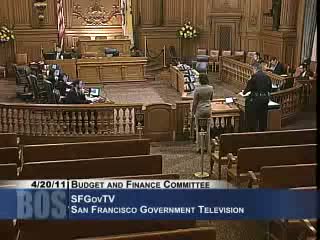
The San Francisco Police Department warned the Budget and Finance Committee on April 11 that an additional 10% contingency reduction could force significant staffing losses and operational changes if alternatives are not found.
Chief Jeff Godown told supervisors that SFPD currently reports about 1,812 full-duty sworn officers and a total sworn headcount of 2,219, but that an additional $11.3 million cut (a second 10% contingency target) could result in the elimination of roughly 171 officer positions across districts. "Conceivably, the worst case scenario would be we could lay off 171 officers," Godown said, noting federal grant-funded hires would be the first affected.
Why it matters: roughly 89% of the department's budget is tied to salaries and fringe. Committee members pressed whether alternative approaches'including negotiating wage concessions, increasing civilianization and accelerating lateral hires'could achieve the required savings without large layoffs.
The controller's office urged caution on an alternative some supervisors raised: extending or preserving the DROP (Deferred Retirement Option Program). Controller Ben Rosenfield said his office'and the systems actuary'find it "unlikely to achieve cost neutrality going forward," estimating approximately $6 million per year in additional retirement costs tied to DROP participants who exit earlier than they otherwise would. "Those two buckets aren't balancing enough," Rosenfield said.
Academy and recruitment trade-offs featured prominently. Department finance staff and the chief said a typical 50-person academy class encumbers substantial salary costs; non-salary classroom and training costs were estimated at about $1,000,000 while total per-class budgetary effects (including salary encumbrances and training staff) were discussed in the range of roughly $4 million in salary plus $1 million non-salary, yielding a round $5,000,000 figure per class as a planning estimate. Chief Godown said the department would need roughly three 50-person classes per year just to replace an average of about 100 retirements per year.
Supervisors also pressed the department on civilianization. The SFPD reported about 398 civilian employees; a prior controller'produced report identified roughly 250 positions now performed by sworn officers that could be performed by civilian staff. Committee members requested a formal civilianization implementation plan, clearer metrics on how many sworn positions could be converted over time, and follow-up on disciplinary backlog and management of accommodated/disability assignments.
What comes next: the committee requested detailed follow-ups including a fuller actuarial and fiscal analysis of DROP from the controller, a proration of academy costs by class and year, the department's civilianization plan, and a technology/IT expenditure breakdown. Item 1 was continued to the call of the chair.
Attribution: quotes and factual attributions in this piece come from the meeting presentation and discussion by Chief Jeff Godown, Deborah Landis (CFO, named by the department during the presentation), Alice Villegomez (SFPD HR director), and Controller Ben Rosenfield.