Get Full Government Meeting Transcripts, Videos, & Alerts Forever!
Get email alerts on the City Budget Projection topic
No spam. Unsubscribe anytime.
Controllers, Mayor’s Budget Office warn of persistent multi‑year shortfalls as Fitch downgrades city credit
Summary
City Controller and Mayor’s budget office presented a joint three‑year general‑fund projection showing a roughly $306 million shortfall in the coming year and larger deficits after that, and flagged depleted reserves, pension costs and reliance on one‑time funds—factors cited by Fitch in a recent downgrade.
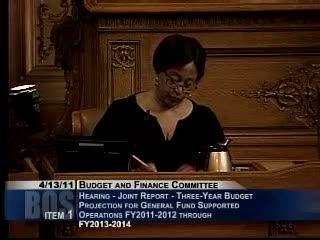
City Controller Ben Rosenfield and the Mayor’s budget director told the Budget and Finance Committee that San Francisco faces a structural imbalance between revenues and expenditures that will continue to produce multi‑hundred‑million‑dollar shortfalls without policy changes.
Rosenfield presented the joint three‑year projection, saying the General Fund faces a projected shortfall of roughly $306 million in the coming fiscal year with larger deficits in later years. He told supervisors the projection assumes modest local economic recovery, status‑quo service levels and CPI increases on open labor contracts, and that the city has assumed a preliminary $30 million revenue loss tied to the unsettled state budget.
"We issued the report last week," Rosenfield said, noting the forecast reflects both modest revenue growth—driven by property‑tax and transfer‑tax improvements—and much stronger projected expenditure growth tied to wages, benefits, capital and debt. He warned that revenue gains alone are unlikely to close the gap: "it's not gonna be a shortfall that we grow our way out of absent policy changes."
Rosenfield also described two large, time‑limited revenue sources that supported recent budgets—federal stimulus funds and a hospital fee program—that are expiring and significantly increase the near‑term gap. He highlighted fund‑balance movements, noting an estimated $10 million improvement in this year’s ending balance offset by a $12.3 million loss tied to rainy‑day reserve availability.
The Controller and Mayor’s budget office laid out three broad balancing scenarios: 1) rely heavily on one‑time solutions to close the coming year’s gap (which leaves larger future shortfalls); 2) a roughly 50/50 mix of one‑time and ongoing reductions; and 3) use ongoing reductions to lessen future deficits. Greg Wagner, the Mayor’s budget director, said department targets and central proposals identify roughly $71 million in citywide solutions and that, even if the mayor and the board accepted all currently proposed departmental cuts and central proposals, a remaining gap of about $65 million would remain to be solved.
The timing and size of state budget actions were singled out as the projection’s largest uncertainty. Rosenfield called the $30 million state‑revenue estimate a "very rough guess" based on current set‑asides and past experience; supervisors pressed for scenario analyses showing deeper state cuts.
The Controller also briefed the committee on recent rating‑agency activity. He said Fitch moved the city down one tier, joining Moody’s in recent downgrades and leaving San Francisco on a "stable outlook" with two agencies. The agencies cited the city’s heavy drawdown of reserves over several years, substantial reliance on one‑time funds in recent budgets, steep pension and retiree‑health costs, and the resulting vulnerability in the event of further revenue weakness. "Our reserve position is dramatically depleted," Rosenfield said, noting general‑fund reserves are now well below the 5–15% benchmark many agencies recommend.
Wagner said the joint report’s improved near‑term number relative to earlier estimates is "welcome news but not enough to fundamentally change" the city’s fiscal challenges. He urged supervisors and departments to weigh difficult policy choices in May and June, and said the mayor’s office would present more detailed proposals and town halls as it develops a tentative budget.
Action: the committee moved to file the joint report and requested that the Controller circulate the rating‑agency comments to supervisors for additional context.
What’s next: supervisors and the mayor’s office said they expect to continue hearings and public outreach through May and June as they finalize targeted departmental actions and the mayor prepares a proposed budget.