Get Full Government Meeting Transcripts, Videos, & Alerts Forever!
Get email alerts on the City Administration topic
No spam. Unsubscribe anytime.
Rules Committee advances Carmen Chu's nomination to full Board amid questions on past tax reductions
Summary
The committee voted unanimously to forward Mayor Breed's nomination of Carmen Chu as city administrator. Chu outlined priorities including COVID response, IT systems and racial equity and denied wrongdoing over Prop 8 property‑tax reductions, citing statewide practice and legal rules.
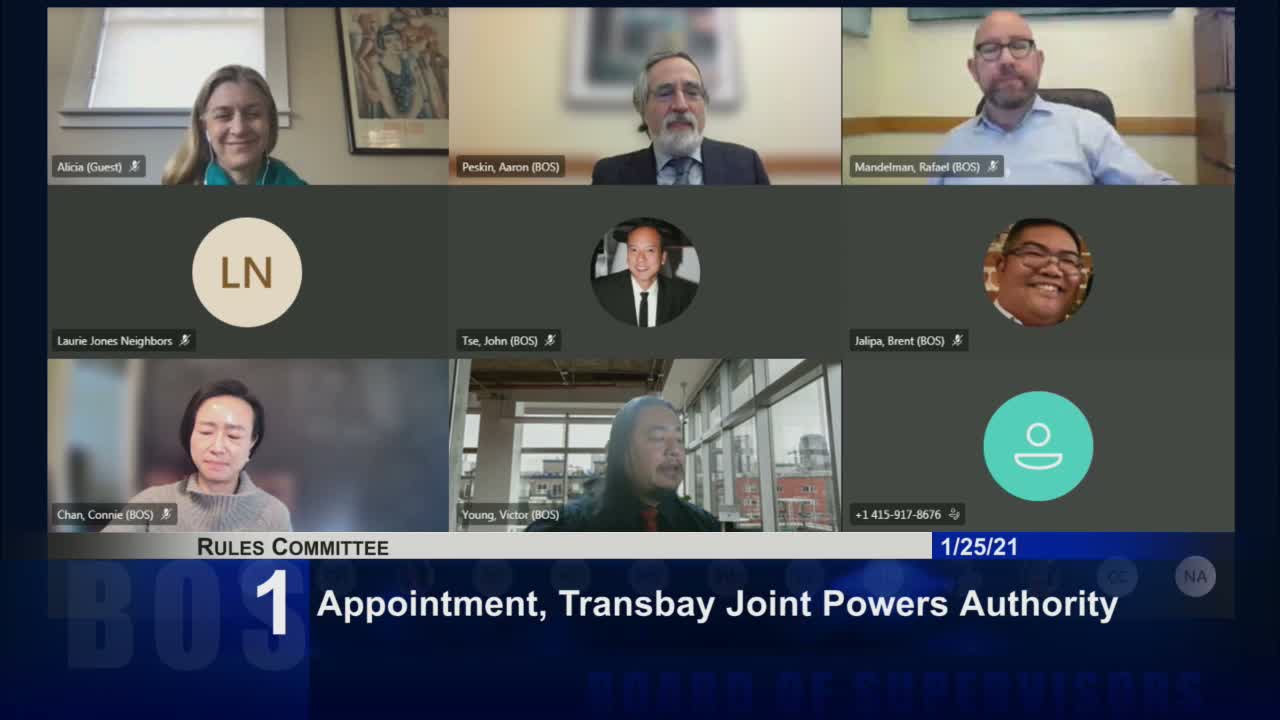
The Rules Committee on Jan. 25 voted unanimously to forward Mayor London Breed's nomination of Carmen Chu to the full Board of Supervisors for confirmation as city administrator, a five‑year appointment slated to begin Feb. 1 if confirmed.
Chair Aaron Peskin described the city administrator as one of the most important non‑elected positions in San Francisco government and introduced Chu, the city's assessor‑recorder and a former supervisor. "This is a position that, much like the controller, is a neutral, non political position in government," Peskin said.
Chu told the committee she leads an assessor's office of about 150 staff and that the office brings in roughly $3 billion in annual revenue; she highlighted launching a new public records system and the first phase of a property tax replacement system. "I think first and foremost we know that the immediate priority that we have right now as a city is to make sure that we're continuing to support our COVID response and our recovery," she said.
Supervisors questioned Chu on several topics including how the assessor's office implemented domestic partnership rules, stalled IT projects such as the Justice Project (a criminal justice data‑sharing effort), the citywide permit‑tracking system and procurement/contracting practices. Chu said many of those issues require understanding legal constraints, interagency coordination and better resourcing; she said she would review project status, legal barriers and possible procurement changes.
Peskin also raised emails alleging that Chu received temporary Prop 8 property‑tax reductions a decade earlier that might reflect impropriety. Chu responded: "I did not ask for any reduction in my property taxes," and explained that under state law the assessor is required to reduce assessments when market value fell below Prop 13 values during the 2008 downturn. She said former Assessor Phil Ting's office proactively reviewed about 14,708 homes statewide and that San Francisco's approach followed state practice. Chu added that her office later worked with other counties and the Legislature on AB 2663 to address related issues.
Peskin also asked about a $200 gift listed on Chu's Form 700 from a person now the subject of a federal indictment. Chu said the gift resulted from food at a public community event where she gave remarks and that she reported it on her Form 700 in the interest of transparency.
Dozens of callers joined remote public comment; many community leaders and nonprofit directors voiced support for Chu and urged prompt confirmation because of the ongoing pandemic response. One public commenter requested a city‑attorney report to clear allegations; Peskin said he had conducted independent checks, concluded there was no special privilege in the Prop 8 action and moved to forward the nomination. The committee's roll call recorded aye votes from Mandelmann, Chan and Peskin; the nomination will go to the full board.