Get Full Government Meeting Transcripts, Videos, & Alerts Forever!
Get email alerts on the Community Development topic
No spam. Unsubscribe anytime.
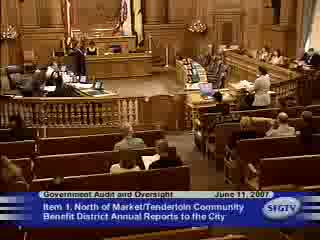
Tenderloin CBD reports cleaning, safety and job gains; residents ask for audits and more board seats
Summary
The North of Market/Tenderloin Community Benefit District told supervisors it increased cleaning, graffiti abatement and neighborhood programming and created transitional employment; residents and service providers pressed for independent CPA reviews, resident board seats and clarity about reserves and spending.
The Government Audit and Oversight Committee heard the annual report from the North of Market/Tenderloin Community Benefit District and multiple other recently created CBDs, and many residents asked supervisors to require clearer financial oversight and more resident representation on CBD boards.
Elaine Zamora, district manager for the North of Market/Tenderloin CBD, told the committee the CBD established a nonprofit corporation and cleaning/maintenance regimes during its first 18 months, including twice‑daily street sweeping, twice‑monthly hot‑water steam and pressure washing, graffiti abatement in partnership with SFPD and DPW, more trash receptacles and beautification efforts. “We have had a strong, productive, and good start,” Zamora said.
Gia Grant of San Francisco Clean City, which provides services under contract to the CBD, reported that crews pick up between 40 and 60 bags of litter and 20 hypodermic needles on a given day and that the CBD’s work led to 100 transitional job opportunities, more than half of those placements coming from the Tenderloin and South of Market neighborhoods.
Public speakers raised governance and fiscal questions. Earl Rogers, chaplain of San Francisco Rescue Mission, urged retaining independent annual audits for CBD funds, calling oversight “not in keeping with the sunshine laws” if an audit is removed. George Dias, representing a 185‑unit condominium building inside the CBD, asked that property‑owner voting rules not be used to exclude residents from board seats when unit owners are late on tax payments; several speakers requested the city attorney review possible exclusions.
Committee members pressed CBD managers about reserve funds and spending priorities. Zamora said carryover reserves were placed in a rainy‑day account to pay for contingencies (for example, water‑intensive cleaning or expanded graffiti abatement) but that the CBD is evaluating spending on cleaning and other initiatives.
After discussion, the committee voted to forward the CBD annual reports with recommendations while noting requests for a CPA review of CBD management contracts and continued attention to resident representation and transparency.
Next steps: supervisors asked staff to include a CPA review clause in the CBD management contract modifications and to monitor reserve usage and resident board participation.