Get Full Government Meeting Transcripts, Videos, & Alerts Forever!
Get email alerts on the Planning Code Amendments topic
No spam. Unsubscribe anytime.
Board committee backs planning-code overhaul to speed affordable projects, tighten notice rules and streamline small rear-yard additions
Summary
The Land Use Committee advanced amendments to the planning code to speed 100% affordable housing approvals, standardize notification procedures, and allow modest rear-yard 'pop-outs' to be approved over the counter while directing the Planning Commission to preserve pre-application notice in certain cases.
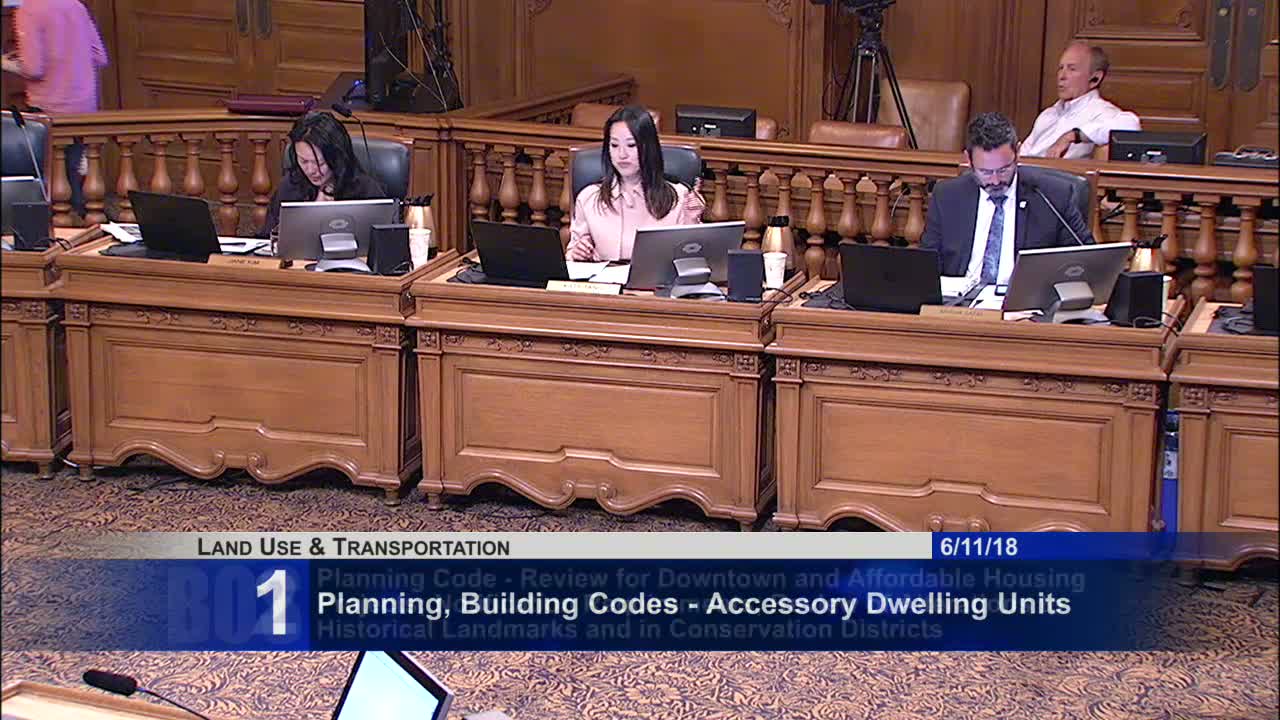
The San Francisco Land Use and Transportation Committee on June 11 advanced a package of planning-code changes aimed at cutting permit delays for affordable housing and simplifying neighborhood notice rules.
The ordinance groups changes into four categories: administrative approval for 100% affordable housing projects, streamlined review for downtown residential projects, fewer hurdles for minor alterations to historic structures, and a uniform approach to public notification. Kanishka Karnarathna of the mayor’s Office of Economic and Workforce Development told the committee that roughly 1,700 affordable units in the city’s pipeline could benefit from administrative approvals and that roughly 1,100 downtown residential units are approved annually under current review processes.
Supporters said the changes would remove duplicative reviews and reduce backlog. Corey Smith of the San Francisco Housing Action Coalition said administrative approvals for 100% affordable projects and clearer notice to tenants would help speed housing into service. Architect Neil Schwartz and advocates from the American Institute of Architects said allowing modest, zoning-compliant rear-yard 'pop-outs' to proceed over-the-counter would let families make limited additions without entering lengthy discretionary review.
Opponents urged caution on notification and serial permitting. Multiple neighborhood advocates and residents said mailed plans should remain larger (they asked for 11-by-17 plans mailed to immediate neighbors), worried that removing 3.11 neighborhood notice for pop-outs would enable larger projects to be pieced together over time, and asked that any relaxation include safeguards. The Planning Commission staff told the committee it recommended retaining notice for limited rear-yard additions and proposed a number of specific fixes: requiring posted notices to be legible from the sidewalk, a minimum half-sheet mailed notice size (5.5" x 8.5"), and a universal 30‑day notice period rather than the 20 days proposed by staff.
Committee members negotiated a hybrid approach. Chair Katie Tang said she favored easing permitting burdens while addressing neighbor concerns; she proposed keeping 3.11 notice for pop-outs when an existing structure had been expanded within the prior three years to help prevent "serial permitting." Planning staff said the three-year limit would reduce attempts to game the rules while allowing modest additions in ordinary circumstances. DBI (Department of Building Inspection) witness Bill Strawn said DBI already notifies immediately adjacent neighbors and the lot behind for building permits and that a 15-day appeal period to the Board of Appeals would remain.
The committee adopted several Planning Commission recommendations (including the visibility/legibility and half-sheet rules) and agreed to direct the Planning Commission via uncodified resolution language to adopt pre-application meeting requirements for pop-outs if notification is reduced. Supervisors also agreed to duplicate the file for substantive amendments that must return to Planning Commission and to continue some technical amendments for further drafting.
What happens next: the committee prepared amended and duplicated files reflecting the agreed edits and will return the item to the board with a recommendation; staff set a continued hearing for July 9. The ordinance as amended will not change demolition controls: planning staff and the mayor’s office confirmed that projects involving demolition remain subject to conditional use authorization and the existing neighborhood-notification and appeal process.