Get Full Government Meeting Transcripts, Videos, & Alerts Forever!
Get email alerts on the Safe Injection Services topic
No spam. Unsubscribe anytime.
Supervisors hear wide public support for DPH—s safe-injection recommendations; DPH estimates 8'12 months to open first sites
Summary
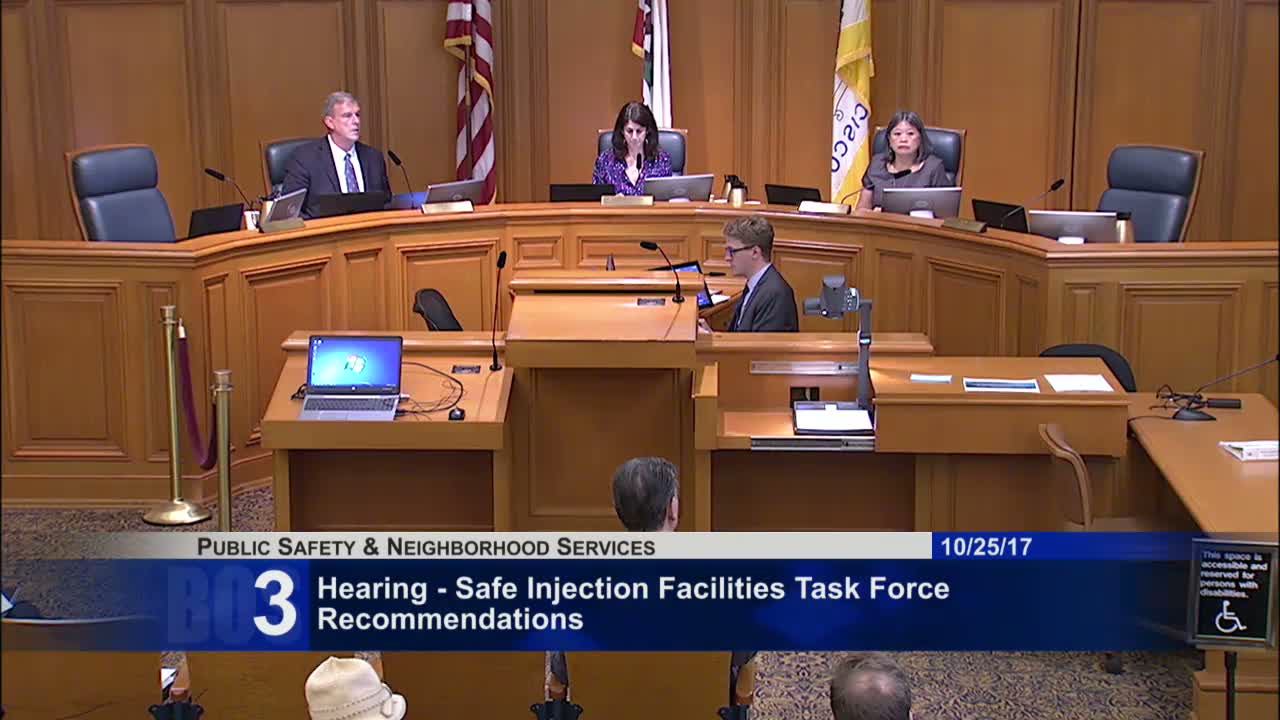
The committee heard the Department of Public Health—s Safer Injection Services Task Force report, extensive public testimony in favor, repeated evidence claims about overdose reductions and cost savings, and directed DPH to develop implementation details while the City Attorney examines legal constraints; the committee continued the item as a call of the chair.
The Public Safety and Neighborhood Services Committee spent the bulk of its Oct. 25 hearing on the Department of Public Health—s Safer Injection Services Task Force recommendations, hearing from DPH staff, national advocates and more than three dozen community speakers before agreeing to continue the item so the department can develop an implementation plan and address legal questions.
President London Breed opened the hearing by describing a personal and policy shift: "What we're doing now isn't working," she said, framing supervised consumption as a possible life-saving, evidence-based intervention. DPH Director Barbara Garcia summarized the task force—s work and said the panel produced 17 recommendations; its first overarching recommendation is that the city support operating safe injection services as part of a harm-reduction continuum. Garcia emphasized the need to address legal and real-estate barriers before opening services.
Speakers from public-health and community organizations described the evidence and local planning. The task force report and presenters cited international experience and local analysis: "there are approximately 100 safe injection sites operating in over 65 cities around the world," President Breed said in opening remarks, and a 2016 local cost-benefit analysis presented to the task force estimated potential savings of about $3,500,000 per year for one site in San Francisco. Laura Thomas of the Drug Policy Alliance reviewed national developments and noted that California Assembly Bill 186 (AB 186) "came within two votes" of passing the Senate this session and will return in January; she urged cooperation with other jurisdictions and suggested a public-health state of emergency could help address legal barriers.
Director Garcia outlined operational design points and a tentative implementation timeline: "It always takes us 8 to 12 months to implement a new program to ensure that the organization has its funding in place," she said, while noting DPH would try to move faster where possible. Garcia also said staffing is a major recurring cost and that renovations or rent could raise overall costs above published estimates; she told supervisors that some existing local providers already have space and services that could host supervised-consumption programs as integrated services.
Public comment was extensive and overwhelmingly in favor. Providers, researchers, peers with lived experience, neighborhood groups and hospitals described the Tenderloin—s needs, emergency-room and overdose-prevention experiences, and community engagement processes already under way. An outreach worker who identified herself as a task-force member said the panel "went very deep" into evidence and local circumstances; a researcher echoed the cost savings estimate and said supervised sites link people to treatment. Speakers with lived experience repeatedly urged urgency; one public commenter said, "I don't wanna die of an overdose alone" and another declared, "I love drug users," reflecting an appeal to dignity and humane treatment.
Supervisors pressed DPH on site numbers and delivery models (fixed facilities, pop-ups, mobile vans). Garcia said multiple, geographically distributed sites would be more effective than a single location because people are unlikely to travel far in moments of acute need. She also warned that mobile and pop-up models add logistical complexity and costs (mobile vans require maintenance, trailers and bathrooms for hygiene) and that staffing accounts for roughly 70 percent of operating costs.
After extended discussion, Supervisor Feuer moved to continue the item as a call of the chair so DPH and the City Attorney could work on legal issues, budget estimates and a concrete timeline; the motion passed without objection. Director Garcia said she will work with the City Attorney and return with cost estimates and an implementation plan. In the hearing, participants repeatedly urged a rapid timetable; DPH—s working estimate for implementation where funding and legal paths are secured remains roughly eight to 12 months.
The committee did not adopt an ordinance or authorize funding at this meeting; it requested further planning and legal analysis and left the item open to future Board action.