Get Full Government Meeting Transcripts, Videos, & Alerts Forever!
Get email alerts on the Redevelopment Bonds topic
No spam. Unsubscribe anytime.
Subcommittee forwards plan to amend Redevelopment budget and allow up to $70 million in Mission Bay bonds
Summary
The Budget and Finance Subcommittee recommended that the Board consider an amendment to the Redevelopment Agency budget to add $5.44 million in tax increment and authorize up to $70 million in bonds, with 20% of proceeds earmarked for a 150-unit affordable housing project in Mission Bay and disputed ERAF payment figures noted.
The Budget and Finance Subcommittee on Thursday voted to forward to the full Board a resolution to amend the Redevelopment Agency’s fiscal 2010–11 budget and to authorize bond issuance authority not to exceed $70 million for Mission Bay redevelopment projects.
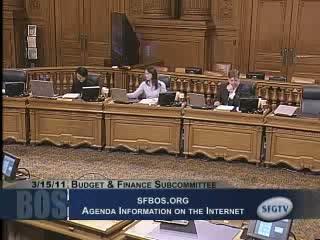
Carmen Chu, chair of the Budget and Finance Subcommittee, opened the special meeting and the committee heard from Amy Lee, deputy executive director of the San Francisco Redevelopment Agency. "I am seeking $5.44 million of additional tax increment to be provided to the developer," Lee told the committee, and said the agency was also seeking authority to sell up to $70 million in bonds to reimburse developers for prior infrastructure work.
The amendment would be funded by accelerated tax assessments in Mission Bay North and South under an existing 1998 master tax-increment financing and development agreement that Lee said directs tax increment from the project to the developer and authorizes the city to issue bonds. Lee said about 20% of the $70 million would support a housing project on Fourth Street — roughly 150 family rental units, including 25 units reserved for formerly homeless families — and about 11,000 square feet of commercial space. She described the housing restrictions as 50% of area median income (AMI) for typical units ("50% of AMI up to 55,880 for [a] four-person household") and cited an income limitation of 16,760 for the formerly homeless units (the transcript notes that figure as "15% of AMI").
The city’s budget analyst presented debt-service estimates, saying, "the estimated annual debt service payment beginning in 11–12 for the not to exceed $70 million tax increment bonds is $6,400,000 and the total debt service is estimated $177,000,000." The analyst also clarified that, because Mission Bay tax increment is pledged to the three-party project (the city, the Redevelopment Agency and the developer), the additional $5.44 million appropriation and pledged debt service would not affect the city’s General Fund in 2010–11 and recommended approval of the requested appropriation.
Committee members pressed the Agency on market timing and options to lower interest costs given a crowded issuance calendar and recent market movement. Supervisor Farrell asked whether the Agency would have come forward absent state developments; Amy Lee said she would have, noting she planned multiple series (A, B, C and D) and was monitoring rates. Ben Rosenfield, City Controller, said redevelopment deals statewide were seeing higher rates this week, adding San Francisco is a strong credit but statewide rates were rising.
Lee also warned that state legislative actions could change the fiscal picture quickly: she said the California Redevelopment Association was negotiating potential amendments that might require additional gross tax increment payments to schools in exchange for extra project years, and that a trailer bill could emerge with little notice. The Agency said it was accelerating work because of that uncertainty.
During public comment Douglas Yap, a 59-year San Francisco resident, opposed the resolution, arguing redevelopment has not benefited some neighborhoods and urging funds be directed more directly to needy residents. "I would like to speak out opposing this resolution," Yap said, citing Fillmore and Japantown as examples where he said the Redevelopment Agency had fallen short.
After discussion, the committee agreed to send the item to the full Board as a committee report with a positive recommendation; the report was scheduled to appear at a special Board meeting at 2:05 p.m. No roll-call vote was recorded in the transcript. The committee adjourned after taking that action.
What remains unclear and will require follow-up: the transcript contains two different references to the ERAF (educational revenue augmentation fund) obligation — Amy Lee described a state-mandated ERAF payment of $6 million due in May, while the budget analyst’s table referenced a smaller ERAF amount (appearing as "3/4 million" in the analyst’s summary). The committee did not resolve that discrepancy at the meeting; the Board or staff follow-up will need to confirm the correct ERAF amount and any impact on timing or bond sizing.