Get Full Government Meeting Transcripts, Videos, & Alerts Forever!
Get email alerts on the Dpw Audit topic
No spam. Unsubscribe anytime.
Budget analyst’s audit finds performance gaps at San Francisco Department of Public Works; DPW outlines fixes
Summary
A budget‑analyst management audit identified chronic planning and project‑management weaknesses at the Department of Public Works, including delayed street projects, poor performance metrics, uncollected fines and capital‑accounting gaps. DPW described implementation steps and pledged follow‑up to the oversight committee.
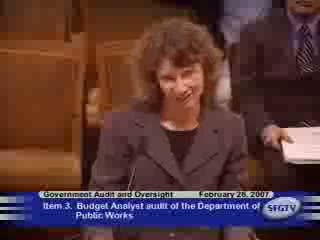
The Government Audit and Oversight Committee heard a management audit of the San Francisco Department of Public Works on the committee’s agenda, where budget‑analyst staff said the department lacks adequate performance measures, has recurring project delays and opportunities to improve collections and contracting practices. Severin Campbell of the budget analyst’s office said the audit identified about $5.5 million in potential cost savings or additional revenue and found that many projects and contracts run late and over budget.
The audit, prepared by a team that included Christine Martin, Sam Jones and Katherine Rauschubert, said DPW’s core functions — repairing streets, managing capital projects and maintaining city facilities — did not have reliable performance standards. “The department lacks adequate performance standards and measures,” the budget analyst said, adding the team found average project delays of about five and a half months and notable multi‑year delays on major street projects.
Audit staff cited examples: the Cesar Chavez Street project experienced nearly two years of delay, including a design change that added roughly $600,000 (about 25% of that project’s budget), and Geary Boulevard had about 546 days of delay in the cases reviewed. On the capital side, the audit called out design problems and inconsistent consultant review that contributed to cost increases; Juvenile Hall’s design issues were estimated to have produced roughly $9 million in overruns. The budget analyst also reported hundreds of project segments that were not reconciled at closeout, with an aggregate negative balance of about $164 million.
The audit highlighted operational weaknesses such as complaint‑driven street‑inspection practices, incomplete street‑tree inventories and weak collections. The bureau that manages street trees oversees about 26,000 of an estimated 106,000 public trees; average pruning cycles were seven years versus a stated goal of three. The budget analyst reported that, of about $1.3 million in litter fines assessed over an approximately three‑year period, DPW recovered roughly $525,000 (about 40.6%). In urban forestry examples, the audit said the bureau collected only 12.6% of a set of tree‑related citations as of August 2006.
DPW officials accepted most of the audit’s recommendations and described multiple near‑term and longer‑term actions. Department leadership told the committee they had prioritized recommendations into three categories (priority 1 — implement within six months; priority 2 — within one year; priority 3 — longer term) and that staff working groups are already tackling many items. On potholes and patching, DPW said it will launch a proactive citywide pothole program in April timed to the reopening of the city asphalt plant and will use a new pavement‑condition scoring to schedule crews by arterial, collector and transit routes.
On contracting and capital management, DPW acknowledged problems that discourage bidder participation and increase change orders and litigation. The department described plans to streamline payment and change‑order paperwork, pursue electronic payment options, create a dedicated cost‑estimating section and convene a cross‑agency implementation group with the mayor’s office, the city administrator and other major agencies to turn the contracting task‑force recommendations into concrete steps. DPW officials cited San Jose as an example of improving bidder participation and reducing litigation through sustained partnership work with contractors.
Committee members pressed staff on coordination with utilities (PG&E, PUC, Comcast), the role of the city’s semiannual interagency coordination group (CULCOP), and how emergency utility work complicates planned resurfacing. Budget analysts and DPW agreed improved coordination, earlier design QA/QC and better project‑level accounting would be essential ahead of two high‑cost projects on the horizon: the Hall of Justice and the San Francisco General Hospital replacement.
The committee continued the audit item to the following week for remaining report sections and follow‑up; DPW and the budget analyst will return with additional documentation and implementation schedules.