Get Full Government Meeting Transcripts, Videos, & Alerts Forever!
Get email alerts on the St Lukes Closure topic
No spam. Unsubscribe anytime.
Supervisors, clinicians and families press CPMC over planned closure of St. Luke’s subacute and skilled nursing units
Summary
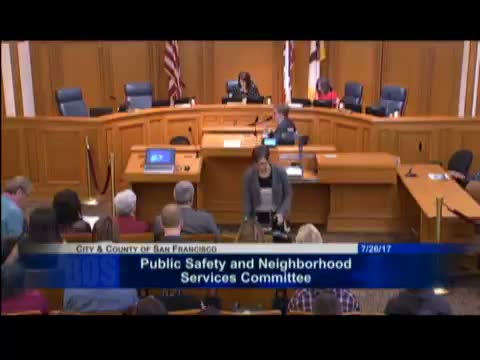
At a July 26 Public Safety & Neighborhood Services Committee hearing, supervisors, public-health staff, clinicians and dozens of family members and nurses protested CPMC/Sutter’s plan to close St. Luke’s subacute and skilled nursing beds by Oct. 31, 2017, and the committee continued the item for follow-up after Health Commission Proposition Q hearings.
San Francisco supervisors, doctors, nurses and dozens of family members pressed CPMC and city agencies on July 26 over the hospital owner’s plan to close the subacute and skilled nursing units at St. Luke’s Hospital, a move city officials said would eliminate the city’s remaining subacute beds and force some patients to relocate out of county.
At the hearing, Chair Supervisor Ronan and co-sponsor Supervisor Safae said the planned closure — which the city has been told will take effect Oct. 31, 2017 — would displace vulnerable patients and staff. Ronan said the closure “will impact and displace 44 vulnerable patients and 72 employees,” and that reports indicate some patients could be sent “as far away as Sacramento.” He added, “We need a plan and we need it now.”
The Department of Public Health cautioned that the agency has limited authority to compel a private hospital to keep licensed skilled nursing beds. Colleen of DPH told the committee, “There really isn't anything within DPH's power to ... make any demands on CPMC with regard to those beds,” and noted that bed licensing rests with the state and that the development agreement governing the hospital rebuilding is silent on skilled nursing beds. DPH also said it would hold two Proposition Q hearings — Aug. 15 and Sept. 5 — to determine the closure’s impact and that the Post-Acute Care Collaborative is working on an action plan.
Physicians and nurses described the clinical consequences. Dr. Teresa Palmer, a geriatrician, said hospital-based subacute units care for patients who require 24-hour licensed nursing and rapid access to intensive care; she told the committee that hospital SNFs provide better outcomes for the sickest patients. Dr. Ken Barnes warned the loss of these beds would lengthen hospital stays and back up emergency and acute services. Dr. Gary Birnbaum, medical director of the St. Luke’s subacute unit, described patients who require ventilators and specialized care and urged that the unit remain open.
Families and front-line staff detailed the human cost in emotional testimony. Multiple relatives said patients — some with tracheostomies and long-term ventilation needs — would face trauma and reduced family visits if relocated many miles away; one speaker asked, “Will they place me? I have no family. I want to die here with dignity.” Nurses and union representatives pressed CPMC to use charity- or community-benefit resources to preserve beds and proposed penalties or conditions if out-of-county transfers occur.
CPMC’s Davies campus chief administrative officer Mary Lanier said the hospital is leading a transition-planning process and “we're working very closely with the families, our conservators and the patients ... to do an individualized plan for an appropriate and safe transition for them.” She acknowledged the new St. Luke’s configuration will not include subacute beds, and said timing for transitions reflected an accelerated opening schedule for the new hospital. A Sutter Health post-acute director described the collaborative’s regional bed survey and said an action plan is forthcoming, but could not guarantee immediate in-county placement for all patients.
Supervisors signaled continued oversight. Multiple supervisors criticized that the 2013 development agreement negotiated with CPMC is silent on skilled nursing and called that omission “appalling.” They asked CPMC to return with data showing whether space could be reserved at the new Cathedral Hill hospital and scheduled continued hearings: the committee moved and passed a motion to continue the item to the call of the chair for follow-up after the Proposition Q hearings.
What officials said and the next steps - DPH: San Francisco currently has about 2,500 general skilled nursing beds and 40 subacute beds; CPMC’s planned closure would reduce hospital-based skilled nursing by about 79 beds (39 general, 42 subacute) and eliminate subacute capacity in the city. - Regulatory process: Proposition Q requires public notice and Health Commission hearings on hospital closures; those hearings were set for Aug. 15 and Sept. 5, 2017. - Committee action: The committee voted to continue the matter to the call of the chair, directing further follow-up and quarterly briefings.
The hearing drew broad public comment and ended with a unanimous-sounding call from supervisors, clinicians, patients and advocates for continued oversight and for CPMC to present concrete alternatives to displacing patients out of city limits. The Health Commission’s Proposition Q hearings and the committee’s follow-up will be the next public opportunities for more detailed findings and possible remedies.