Get Full Government Meeting Transcripts, Videos, & Alerts Forever!
Get email alerts on the 911 Response Staffing topic
No spam. Unsubscribe anytime.
Supervisors Hear Urgent Calls to Fix 911 Staffing as Response Rate Lags
Summary
Supervisors pressed city emergency managers on June 12 after presentations showing San Francisco answered 74.8% of 911 calls within 10 seconds through May, below the 90% national standard; dispatchers and unions urged reclassification, better pay and emergency hiring and retention steps.
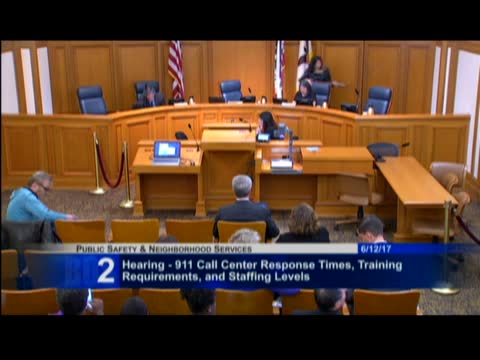
Supervisors at a June 12 special meeting of the Board—of—Supervisors—Public Safety & Neighborhood Services Committee pressed city officials to take immediate steps to address a staffing crisis at the city——11 call center that has left response performance well below the national standard.
"There is no more important duty for members of the elected family—... than dealing with public safety," Supervisor Peskin said in opening remarks, framing the hearing after a large increase in calls and a recent PG&E outage that strained dispatch operations. The Office of the Controller and the Department of Emergency Management (DEM) presented data showing call volume has risen roughly 37 percent since 2011 while fully trained dispatcher headcount fell from about 149 to as low as 117 before modest recent hires.
The controller's performance manager, Natasha Mihal, described benchmarking the city against peer jurisdictions and noted the national standard that emergency calls should be answered within 10 seconds 90 percent of the time. "Our call response this fiscal year through May is 74.8 percent," Mihal said, and directed supervisors to sfgov.scorecards for the underlying monthly data.
DEM Deputy Director Rob Smuts laid out the agency's diagnosis and near-term plan. He said increases in medical calls, low-priority police or "quality-of-life" calls (including reports tied to homelessness), and a rise in accidental dials together explain much of the volume growth. Smuts said the department has hired 43 people in three academy classes and is sequencing training so more staff reach solo duty earlier; full training typically takes about nine months. "We went from 149 to 117 dispatchers," Smuts said. "We're now at 123, I believe, and we're asking for budget authority to reach a sustainable staffing level." He described two target thresholds: roughly 145 fully trained dispatchers to meet the standard with extensive overtime, and about 163 for a more sustainable overtime level.
Supervisors pressed DEM on stopgap measures. Officials said they are pursuing multiple tactics: bringing back retirees under Prop F short-term, exploring temporary hires, recruiting lateral staff from other agencies, asking for budget authority for additional academy classes and considering light-duty assignments for sworn personnel where contractually possible. Smuts also flagged operational constraints such as limited floor space, computer-aided-dispatch terminals and parking for 24/7 staff.
Frontline dispatchers and union leaders gave extended public testimony describing long hours, mandatory or quasi-mandatory overtime, morale problems and a high burnout rate. SEIU Local 1021 Vice President Natalie Elisuch said the city lost about 40 dispatchers since mid-2014 and urged reclassifying dispatchers into a public-safety retirement tier, higher base pay, retention bonuses and stronger whistleblower protections. "We are the first—first responders," several speakers said, urging concrete compensation and scheduling changes so experienced staff do not leave.
Demonstrating the human toll, multiple dispatchers described routinely working 12- to 16-hour shifts, missing family events and returning immediately to take the next crisis call. Department officials acknowledged the severity and said recent hires and planned classes should improve staffing by late 2017 and into early 2018, but stressed that graduation rates (historically ranging from roughly 40 to 80 percent) and future attrition make projections uncertain.
Board members and union leaders agreed the city needs both emergency interim steps and longer-term solutions. Supervisor Peskin said he intends to seek budget support for public education (to reduce nonemergency and accidental 911 calls), hiring incentives and other measures, and the committee voted to continue the item to the call of the chair for follow-up hearings and budget work.
What's next: supervisors asked DEM and the mayor's office for specific budget requests, a timetable for expected staffing milestones, and proposals for interim relief (retiree rehiring, per-diem/lateral hires, and negotiated contract changes). The committee will reconvene to review those items.