Get Full Government Meeting Transcripts, Videos, & Alerts Forever!
Get email alerts on the City Budget topic
No spam. Unsubscribe anytime.
San Francisco budget briefing: controller outlines revenue mix, voter set-asides and new reserve rules
Summary
City finance staff told the Budget & Finance Committee the general fund (~$3.0B) is constrained by voter-approved set-asides and baselines that together consume hundreds of millions, and described rainy day and new budget stabilization reserves intended to smooth multi-year downturns.
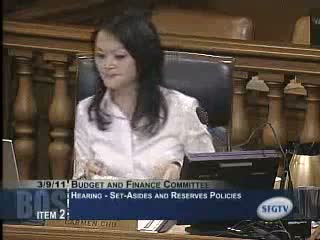
The Budget and Finance Committee heard a controller-led briefing on the composition of San Francisco—s revenues and the mechanics of voter-approved set-asides and reserves.
Controller Ben Rosenfield introduced Comptroller—s Office staff who walked supervisors through the city—s revenue picture: the full city budget is about $6.5 billion, while the general fund is roughly $3.0 billion. Michelle Alersma, citywide revenue manager, said charges for services (PUC water rates, airport fees, etc.) make up the largest portion of the total budget, while within the general fund property tax (about $1 billion) and state revenues are the largest slices. She told the committee that voter-approved set-asides (for example the children—s fund, library preservation fund and open space fund) total about $110 million this fiscal year and are deposited to special revenue funds rather than the general fund.
The presentation explained baselines required by the Charter and ordinances. Leo Levinson (Comptroller—s Office) said "aggregate discretionary revenue" -- a Charter term -- was about $1.9 billion in FY2010-11 and that baselines and other charter-mandated allocations currently total roughly $372 million of that amount. Levinson described the public education enrichment baseline (Prop H) and noted a charter provision allowing the mayor and board to defer up to 25% of the annual contribution if the joint projected shortfall exceeds $100 million; deferrals are accruable and, under current assumptions, must be repaid by 06/30/2018 unless the baseline is extended.
Committee members pressed staff on how much of the general fund is truly discretionary after baselines, employee-benefit obligations and state or federal restrictions; Rosenfield and Levinson said the discretionary share depends on how items are counted but estimated it lies between roughly one-third and one-half of the general fund (about $1.0 billion to $1.5 billion). Rosenfield added rating agencies consider aggregate reserve balances when evaluating the city—s credit and that the city—s current reserve posture (a $25 million general reserve plus roughly $30 million rainy day balance at the time of the presentation) is light relative to common practice.
Staff reviewed three reserve types: the rainy day reserve (established 2003; deposits triggered when general fund revenue growth exceeds 5%, withdrawals permitted when revenues fall below the prior year), a budget stabilization reserve (created by the Board the prior April to supplement the rainy day reserve and provide a multi-year cushion), and a general reserve target set under Prop A to rise gradually to 2% of the general fund. Levinson described deposit triggers for the stabilization reserve (property transfer tax above the 5-year average, year-end windfalls, and non-property asset sales) and said 75% of eligible windfalls would be deposited there; together the rainy day and stabilization reserves are capped at no more than 10% of general fund revenues.
Levinson summarized next steps: updated revenue tracking and a formal joint report with the Mayor—s office and the budget analyst at month—s end, followed by a five-year financial plan in early May. He and Rosenfield emphasized that current projections were preliminary and subject to change as the joint report is finalized.
Why it matters: supervisors must weigh statutory baselines and voter set-asides when balancing departmental needs and potential budget cuts. The presentation framed reserves as a multi-year insurance mechanism rather than a single-year fix and identified trade-offs between immediate appropriations and long-term reserve rebuilding.
Sources: Controller Ben Rosenfield; Michelle Alersma, citywide revenue manager (Comptroller's Office); Leo Levinson (Comptroller's Office).