Get Full Government Meeting Transcripts, Videos, & Alerts Forever!
Get email alerts on the Redevelopment Elimination topic
No spam. Unsubscribe anytime.
State realignment and a plan to abolish redevelopment agencies put local projects and affordable-housing pipeline at risk, San Francisco officials warn
Summary
City officials, including the Redevelopment Agency director, told supervisors that the governor—s proposal to eliminate redevelopment agencies and realign state programs could jeopardize projects such as Transbay, Treasure Island and Hunters View and disrupt affordable-housing financing unless trailer bill language is amended.
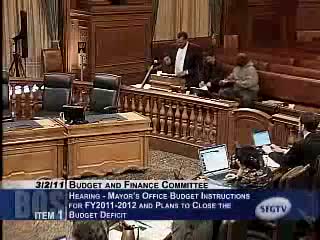
City officials warned the Budget & Finance Committee on March 1 that the governor—s budget and accompanying trailer bill language — which assumes moving redevelopment funds into the state general fund and abolishing redevelopment agencies by July 1 — could halt or slow major local projects and weaken the city—s affordable-housing pipeline.
Fred Blackwell, director of the San Francisco Redevelopment Agency, told the committee that the governor—s trailer bill would freeze redevelopment activity on enactment and create successor entities to wind down existing obligations. "If we were unable through successor entities to issue debt or to assume land-use control," Blackwell said, "development in each one of those projects would essentially stop."
Blackwell disputed the administration—s $1.7 billion statewide savings figure for year one, saying it is derived from a 2008-09 controller—s report that overstates current revenues; the coalition of large cities produced a lower estimate of about $900 million. He described the mayors' alternative (the "big 8" proposal) that would secure funding through pass-through fees and programmatic reforms intended to protect affordable-housing commitments and increase transparency.
Local projects Blackwell said could be at risk include Mission Bay, Transbay, Treasure Island, Hunters View and early phases of shipyard-area developments (including Alice Griffith). He said roughly $100 million set aside for affordable-housing pipeline work remains partly uncommitted and that if successor entities cannot issue debt or fund asset management, both ongoing projects and management of existing affordable units (he cited ~11,000 affordable units managed by the city/agency) could suffer.
The mayor—s office and agency staff said constitutional and statutory hurdles complicate alternatives: Bond or pass-through proposals raised concerns about Proposition 22 (which limits the state—s ability to take local funds) and Proposition 58 (constraints on state borrowing). A conference committee in Sacramento is reconciling assembly and senate versions of the budget; officials said the governor asked for a March 10 deadline for committee work but warned the timeline may slide.
Blackwell and Kate Howard of the mayor—s office said they are negotiating amendments to trailer language to clarify what counts as an "existing obligation," and what powers successor entities would have, particularly the ability to issue debt to meet contractual commitments. They urged supervisors and the mayor—s staff to press Sacramento for language that ensures projects with substantial completion or existing legal commitments can move forward.
Next steps: city offices will continue negotiations with state finance staff and the governor—s office, monitor conference committee action, and seek trailer-bill amendments to protect the city—s obligations and affordable-housing investments.