Get Full Government Meeting Transcripts, Videos, & Alerts Forever!
Get email alerts on the Cannabis Land Use topic
No spam. Unsubscribe anytime.
San Francisco supervisors split over cannabis land‑use rules as Jan. 1 deadline looms
Summary
Supervisors debated buffer distances, daycare inclusion and temporary permits for medical cannabis dispensaries, with labor and industry urging swift action to prevent business closures and community groups urging stricter limits to protect children.
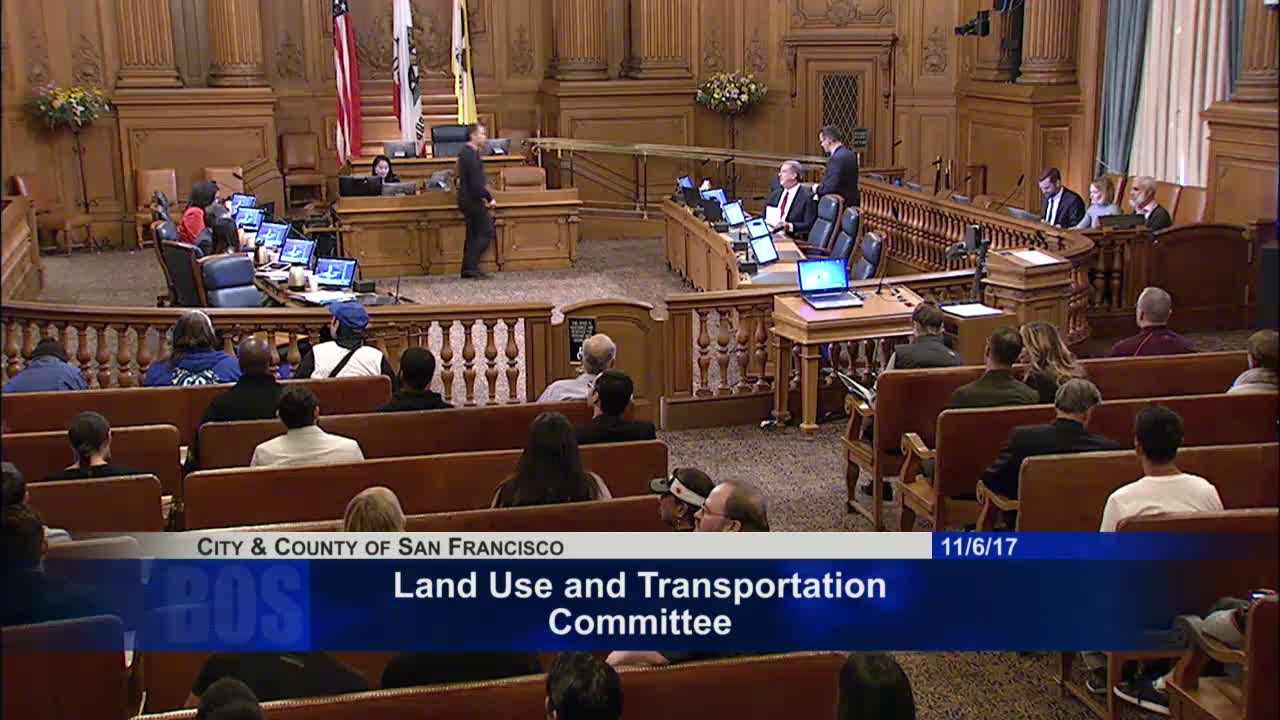
SAN FRANCISCO — The Board of Supervisors’ Land Use and Transportation Committee spent much of a single hearing wrestling with how to turn voter approval of adult cannabis into local rules that balance access, neighborhood character and equity.
Acting Chair Aaron Peskin opened the meeting by urging patience and breadth: “I would rather get this thing done right,” he said, arguing against a hurried fix to meet the state’s Jan. 1, 2018, implementation timeline.
Why it matters: The committee is drafting a planning-code ordinance to regulate where adult‑use cannabis businesses may locate, whether and how existing medical cannabis dispensaries (MCDs) can convert to adult retail, and how to protect equity applicants who were disproportionately affected by past enforcement. A central dispute is whether to use a 600‑foot buffer — the state’s suggested baseline — or a 1,000‑foot buffer from schools and other sensitive uses, and whether to include daycare centers in the definition of sensitive uses.
Supervisor London Breed, sitting in as committee president, warned that a patchwork of district‑by‑district caps and expanded buffers could ‘‘significantly reduce or even eliminate any new opportunities’’ for equity applicants and narrow the city’s allowable retail areas. “We have to create good policy for the city as a whole,” she said.
By contrast, Supervisor Jeff Sheehy urged an interim permitting approach to let existing medical dispensaries convert to adult use right away, arguing that delays would damage the local supply chain and put businesses out of business. “We will literally be shutting down local businesses if we don’t have something in place by January 1,” Sheehy said.
Staff and legal context: Deputy City Attorney John Givner told supervisors that if the board did not adopt and the mayor sign a local ordinance, the city could continue to authorize preexisting MCDs to operate under existing medical rules but would not be positioned to say it authorizes adult‑use retail to the state. Nicole Elliott of the Office of Cannabis added that the state will look to local authorization when deciding whether to issue state licenses, and that gaps in local regulation could put local operators at a competitive disadvantage.
Public comment: The committee heard hours of testimony from several hundred speakers. Business groups, cultivators, unions and many industry representatives urged a 600‑foot buffer, protections for pipeline applicants and a temporary conversion pathway. ‘‘We urge you to move swiftly to pass legislation in the next few weeks so businesses can be legalized,’’ said Jim Lazarus of the San Francisco Chamber of Commerce. Patient advocates and equity groups also urged protections for longstanding medical providers and low‑income patients.
Opponents — including parents, teachers and community groups — urged stricter limits. Several speakers asked the board to maintain or adopt a 1,000‑foot buffer and to include childcare and preschool facilities among sensitive uses; others asked for stronger neighborhood notice and more time for outreach in languages other than English.
Next steps and procedure: The committee agreed to prepare two tracked versions of the ordinance for further public review: a ‘‘clean’’ citywide version (aimed at a uniform approach) and a ‘‘duplicated’’ version that includes several district‑specific amendments already proposed by supervisors. The committee also accepted revised language to treat certain pipeline MCD applicants as eligible to convert if they submitted complete Department of Public Health applications by the summer cutoff date. Members said they will reconvene next week to advance the matter, with the possibility of sending the issue to a committee‑of‑the‑whole for broader board input.
What was not decided: The committee did not adopt a final buffer distance, did not vote to include or exclude daycare centers from the definition of sensitive uses, and did not finalize whether conversions would require neighborhood discretionary review in particular zones. Staff and counsel warned that those choices affect many zoning sections and require carefully drafted cross‑references before a legally robust hearing.
The committee’s procedural votes included sending a separate commemorative street‑naming item (Tony Bennett Way) to the full board with recommendation and continuing several non‑cannabis items for further work.
What’s next: Committee members said they want to use the intervening week for negotiation and precise drafting so the board can take a more orderly, public vote rather than rushing ad hoc changes. The committee left open the possibility of temporary permits that would allow existing MCDs to operate while their administrative article‑16 permits and land‑use approvals are processed.
Reporting note: Quotations in this article come from the committee hearing transcript, the Office of Cannabis, and public commenters who addressed the panel.