Get Full Government Meeting Transcripts, Videos, & Alerts Forever!
Get email alerts on the Hud Budget Hearing topic
No spam. Unsubscribe anytime.
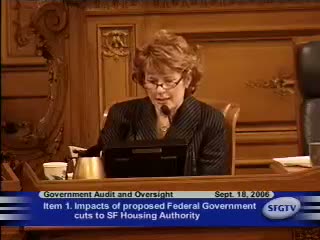
SF supervisors hear urgent warnings as HUD operating-subsidy cuts threaten public-housing services and safety
Summary
San Francisco officials and residents warned that proposed federal HUD funding changes and proration could cut roughly $4 million from the Housing Authority's operating budget next year, risking maintenance, security and services for thousands of low-income, elderly and disabled residents; the committee asked staff to draft a city resolution and seek short-term policing costs for an affected site.
San Francisco supervisors and housing officials on Tuesday heard stark warnings that proposed federal funding changes for public housing could force immediate service reductions, layoffs and worsened safety at public-housing sites across the city.
Dr. Fortner, director of the San Francisco Housing Authority, told the Government Audit and Oversight Committee the housing authority faces an operating-subsidy reduction tied to HUDs shift to an asset-management funding model. He said the authoritys earlier projection of a $7 million loss was reduced through advocacy and technical adjustments to roughly $4 million, but that even a $4 million shortfall "is a bad environment" the agency cannot absorb with current reserves.
A representative of the Mayors Office of Housing said the office is exploring state funds and proposed bond measures to offset the federal gap but warned that $4 million in cuts would leave less money for planned revitalization work. An unidentified federal-policy presenter summarized national developments, saying housing authorities nationwide were told earlier this year they would receive higher proration levels, then were retroactively cut; San Francisco was described as among the "top 10 loser" agencies under the new formula and could lose another $7 million over five years if conversion to asset-management is not accomplished.
Public testimony filled much of the hearing. Labor and union leaders urged the city to stand with residents in lobbying Congress; residents from Mission Dolores, Alemany, Civic Center and other developments described delayed repairs, frequent elevator failures, dark hallways, robberies and two recent homicides at the Alemany site. "I want good maintenance. I want good security," said Walker Dukes, a disabled Mission Dolores resident, describing a fire that took three years to repair. Neighbor and community speakers urged dedicated policing dollars for Alemany and immediate intervention to prevent displacement.
Committee members pressed SFHA on mitigation strategies. Dr. Fortner listed three priorities: secure additional federal appropriations; reengineer operations to maximize service within available resources; and leverage city partnerships (police, DPW, city attorney, redevelopment) to preserve services. He added that SFHA is in labor negotiations with 10 unions and that past shortfalls forced the agency to lay off workers and slow routine maintenance.
Chair Tom Ammiano said he would introduce a resolution the next day urging a city supplemental to cover this years shortfall and requested that Chief Fong and SFHA provide a cost estimate within a week for a three-month, two-officers-on-foot pilot at Alemany (seven days a week, six hours a day). The committee did not take a final vote on a substantive policy at the hearing.
The hearing highlighted a mix of immediate operational risk (security and repair backlogs at specific developments) and longer-term budget uncertainty tied to federal policy changes. Committee members and advocates said they plan further hearings and joint advocacy with the mayor's office and the citys congressional delegation.