Get Full Government Meeting Transcripts, Videos, & Alerts Forever!
Get email alerts on the Litter Waste Management topic
No spam. Unsubscribe anytime.
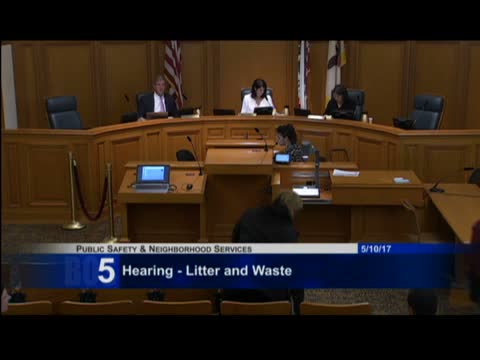
Supervisors hear detailed briefings on litter, hot-spot crews and waste programs; item continued
Summary
The committee held an in-depth hearing on litter and waste-management strategies including DPW operations, controller and 311 data, Recology programs and Department of the Environment outreach; public commenters urged source reduction, more drop-in resources and better coordination. Supervisor Feuer requested the item be continued to the call of the chair.
Supervisor Sandra Lee Feuer convened a committee hearing on neighborhood litter and packaging waste, citing constituent complaints and the Controller’s recent report showing increases in illegal dumping in District 1. Chelsea Boyard opened for Supervisor Feuer, requesting city departments provide an overview of litter tonnages, emerging trends and strategies.
Larry Stringer, Deputy Director of Operations for the Department of Public Works, said street-cleaning requires a multi-department, multi-jurisdiction response and described DPW operations: manual cleaning and mechanical street-sweeping budgets (roughly $29 million and $11.1 million, respectively), hot-spot crews dedicated to encampments (three crews averaging roughly 55 tons/month from encampments), alleyway night crews, corridor workers (roughly 80–85 currently; goal 130) and volunteer programs such as Adopt-a-Street and the Giant Sweep campaign. Stringer said DPW is piloting additional public receptacles on Mission Street and testing reclaimed-water uses for cleaning.
Luke Fuller of the Controller’s Office summarized the annual street-and-sidewalk maintenance standards report and described methodology limitations (183 routes evaluated twice yearly; district-level precision limited) and the office’s effort to augment that work with monthly evaluations of selected commercial routes and with SF311 data.
Nancy Alfaro (311) reported a 61% increase in service requests from 2015 to 2016 citywide and noted the top categories included boxed/bagged items, carts, overflowing garbage, electronics and encampments; she cautioned that 311 data carry reporting bias. Paul Giusti (Recology) described abandoned material collection services (on track for about 110,000 stops and ~4,400 tons this year) with average response under five hours, bulky-item recycling by appointment and daily servicing of roughly 3,500 city litter cans.
Julie Bryant (Department of the Environment) summarized prevention and education work: school assemblies, targeted campaigns (including a cigarette-litter effort with Surfrider) and existing city policies (bag, Styrofoam and bottled-water prohibitions) that reduce litter at source.
Public commenters urged a mix of source-reduction policies (fees on commonly littered items), more consistent encampment cleanup protocols with coordinated social services, improved recycling access, reintroduction/expansion of drop-in services and better oversight of homeless-program spending. Several speakers emphasized equity concerns and the need for culturally competent outreach. Supervisor Feuer asked the item be continued to the call of the chair for additional follow-up; the request was granted without objection.