Get Full Government Meeting Transcripts, Videos, & Alerts Forever!
Get email alerts on the Vacant Storefronts topic
No spam. Unsubscribe anytime.
San Francisco hearing spotlights gaps in enforcing vacant‑storefront rules as city weighs policy changes
Summary
The Land Use Committee heard a Budget & Legislative Analyst report and OEWD retail study showing uneven data, low compliance with vacancy registries and concentrated vacancies; members urged DBI to adopt proactive enforcement and recommended follow‑up work while filing the retail study.
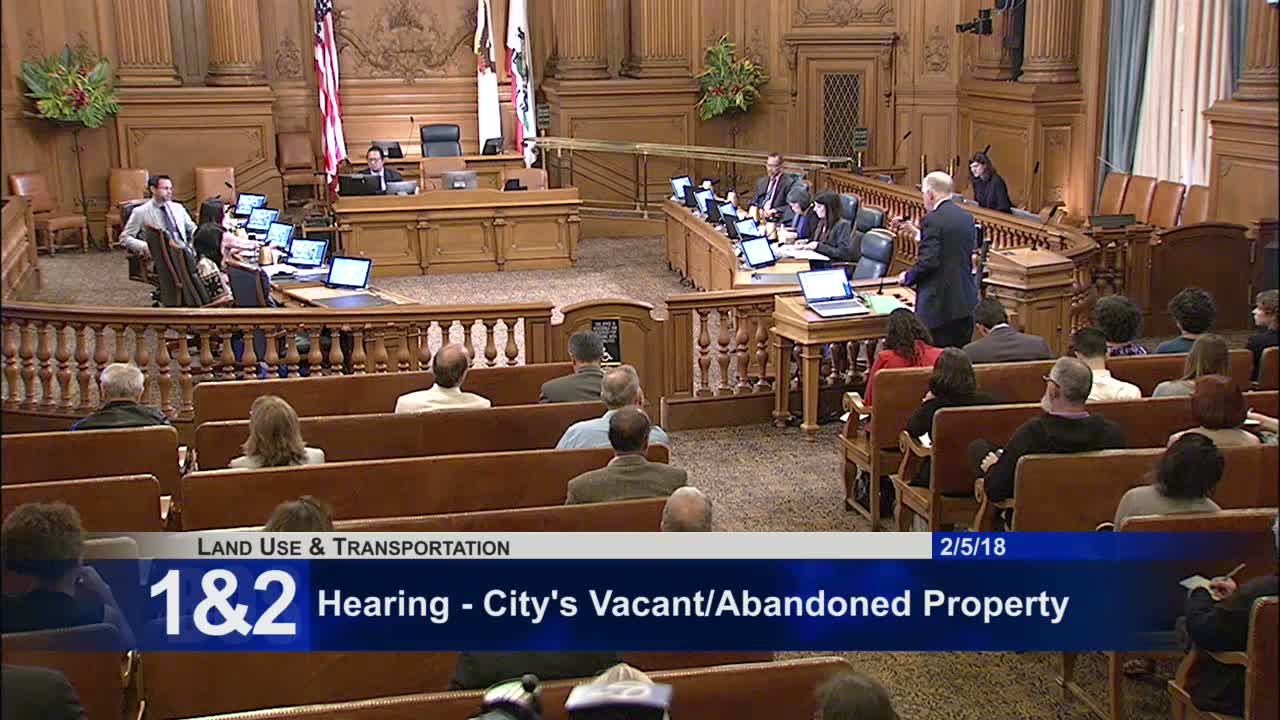
The San Francisco Board of Supervisors Land Use Committee on Feb. 5 examined persistent commercial vacancies and enforcement gaps after presentations from the Budget & Legislative Analyst and the Office of Economic and Workforce Development.
The Budget & Legislative Analyst, Fred Brusso, told the committee that two city ordinances require owners of vacant or abandoned buildings and storefronts to register with the Department of Building Inspection and pay an annual $711 fee, but the registries capture only a small fraction of vacant properties and are geographically concentrated. "We concluded that there is low compliance with the two ordinances," Brusso said, noting registry counts that are small relative to citywide vacancy measures and the lack of proactive DBI outreach.
Why it matters: Committee members and dozens of public commenters said long‑term vacancies can cause blight, depress surrounding businesses and reduce neighborhood vitality. Supervisors described examples where clusters of empty storefronts on single blocks undermined corridors even where average vacancy rates appeared healthy.
OEWD deputy director Joaquin Torres and Strategic Economics consultant Sarah Graham laid out national retail trends — declines in some traditional retail categories and growth in experiential, food and personal‑service uses — and summarized OEWD’s biannual survey of 24 corridors and programs intended to prevent and fill vacancies. OEWD emphasized technical assistance, targeted small‑business loans, façade and tenant‑improvement grants and district marketing as tools.
Committee discussion centered on enforcement and data. "Complaint-driven is not going to work," Supervisor Feuer said, urging DBI to adopt more proactive identification and enforcement. DBI assistant director Ron Tao said the department’s enforcement has been complaint‑driven and tracked in Excel, and that a planned permit and project tracking system could improve capabilities once implemented; he cautioned that staff resources are limited and that the new system was scheduled to go live later in the year.
Public reaction: Merchants associations, neighborhood groups and business improvement districts urged stronger penalties for absentee or nonresponsive landlords, better outreach to monolingual owners, faster permitting for small businesses, and tools to attract more foot traffic. A coalition of unions and housing advocates supported flexibility that could allow neighborhood‑serving uses and job pathways tied to development.
What the committee did: Members asked DBI and the City Attorney for follow‑up data on enforcement outcomes, referrals and repeat offenders and to return with measurable steps. The committee continued Item 1 (vacant/abandoned property/enforcement) at the call of the chair for additional information and filed Item 2 (the retail study report).
Next steps: The committee requested that DBI present enforcement outcomes, proposed staffing/resource needs to implement a proactive program, and more granular corridor‑level data on vacancy concentration and duration.