Get Full Government Meeting Transcripts, Videos, & Alerts Forever!
Get email alerts on the Liquor License topic
No spam. Unsubscribe anytime.
Committee forwards Harry Harrington’s liquor‑license application after police report and applicant comments
Summary
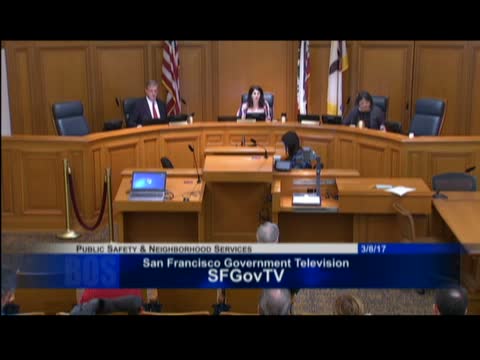
The Public Safety and Neighborhood Services Committee voted without objection to forward a Type 48 on‑sale liquor license application for Harry Harrington’s Pub at 456 Larkin to the Board of Supervisors after police staff described recommended conditions and the applicant spoke about neighborhood revitalization.
The San Francisco Board of Supervisors’ Public Safety and Neighborhood Services Committee voted to send forward an application to extend a Type 48 on‑sale liquor license for Donegal All Blacks LLC, doing business as Harry Harrington’s Pub, to the full Board of Supervisors for consideration.
Sergeant Gigi George told the committee she had submitted an amended Police Code Notification (PCN) report correcting the approving station to Tenderloin Station and that the report showed zero letters of protest or support. She said the pub’s location is in a high‑crime, high‑saturation census tract. The Police Department’s Alcoholic Beverage Ordinance (ALU) recommended conditions that include no off‑sale alcohol and that no noise be audible beyond the licensee’s area of control; Sergeant George said the applicant agreed to those conditions.
Peter Friel, speaking for Harry Harrington’s, described the business as a long‑standing neighborhood establishment, saying the pub has been at its general Larkin Street location since about 1922 and that the applicant hopes to revitalize an adjacent vacant storefront to create a community lounge and private‑party space. “We just wanna bring it back to where it was prior to the fifties,” he said, describing efforts to increase neighborhood activity and host community events.
Committee members expressed concern about administrative delays in the planning process that they said had extended the time to process the application well past the expected 90‑day window, a delay one supervisor said had lasted roughly 14 months. After the presentation and brief questions, with no public comment, a committee member moved to send the item forward and the motion passed without objection.
The action recorded in committee was procedural: the item was forwarded with the committee’s recommendation for consideration by the full Board of Supervisors. No final licensing decision was made at the committee meeting.