Get Full Government Meeting Transcripts, Videos, & Alerts Forever!
Get email alerts on the Infrastructure Finance topic
No spam. Unsubscribe anytime.
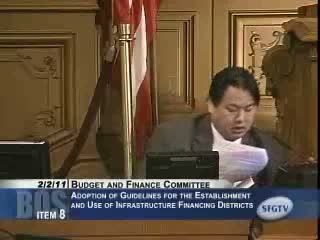
Board committee forwards Rincon Hill IFD pilot and citywide IFD policy package amid fiscal safeguards
Summary
Staff proposed citywide infrastructure-financing district (IFD) policies and a pilot IFD for Rincon Hill to finance parks and streetscapes; the committee amended the package, set caps and safeguards, and forwarded the items with recommendations.
City staff from the Office of Economic and Workforce Development, Planning, Redevelopment and the Controller’s Office presented a package of resolutions and a draft ordinance to create citywide policies for Infrastructure Financing Districts (IFDs) and to launch a Rincon Hill pilot. Staff framed IFDs as a tax-increment financing tool distinct from redevelopment that can fund capital infrastructure (not ongoing maintenance or housing except in narrowly defined cases), has a 30-year maximum life, and requires owner or voter approval.
Michael Yarny (OEWD) summarized the pilot: 17 parcels and up to 10 potential project sites in the Rincon Hill area, roughly 2,500 housing units in prospective development and an estimated 2.5 million square feet of new floor area. Project-level infrastructure costs were estimated at about $31.9 million (non-inflated) for parks, living-street and better-streets redesigns. Staff proposed matching roughly half the infrastructure budget using IFD proceeds and capped cumulative increment diversion at $60.2 million (nominal) and bond issuance authority at $22 million (with staff estimating $15 million likely needed).
Staff and the budget analyst described fiscal safeguards: the IFD package assumes passthroughs to schools and other base beneficiaries are not taken; the IFD would divert an estimated 16 percent (about $41 million) of non-inflated net increment over 30 years while about $214 million of increment would flow to the general fund; a fiscal-impact study (appended to the plan) projected a net general-fund surplus after build-out. Proposed city policy thresholds include limiting IFDs to rezoned area plans or PDAs, requiring a projected net fiscal benefit and limiting cumulative diversion to 50 percent over the 30-year term (with further board approvals required for allocations to a special fund).
Public commenters for and against weighed in; neighborhood advocates and developers emphasized the need for parks and safer streets, while other residents urged caution about diverting general-fund revenues. After discussion, the committee adopted technical amendments, forwarded several ordinance/resolution files with recommendation and continued a related hearing to the call of the chair.