Get Full Government Meeting Transcripts, Videos, & Alerts Forever!
Get email alerts on the Bicycle Chop Shops topic
No spam. Unsubscribe anytime.
Supervisor Sheehy wins committee approval to shift 'chop shop' enforcement to Public Works with new appeal rules
Summary
The committee approved amendments to move an ordinance targeting bicycle 'chop shops' out of the Police Code and into the Public Works Code, assigning DPW authority to issue notices of violation and seize parts (held 30 days) with a 3-day hearing timeline and a clear-and-convincing evidentiary burden on DPW. Public commenters split over civil‑liberties impacts.
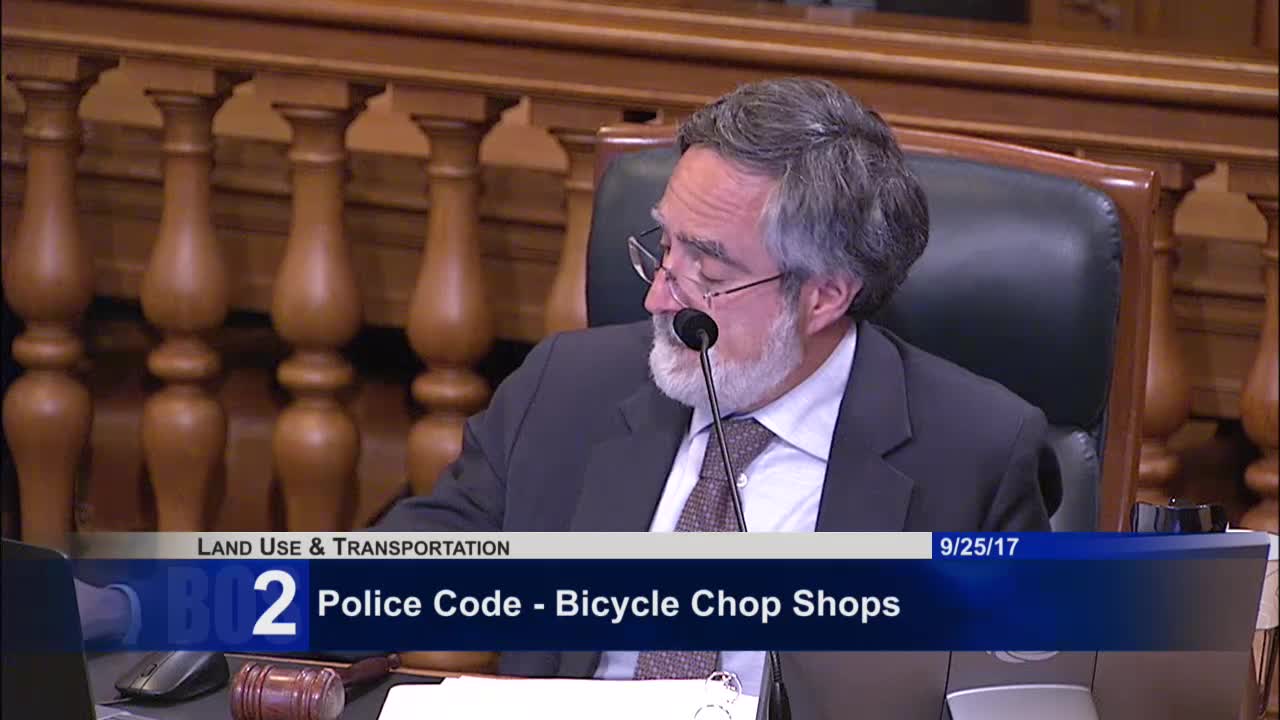
Acting Chair Aaron Peskin and the Land Use and Transportation Committee voted without objection to send amended legislation to the full Board that would move an ordinance targeting so‑called bicycle “chop shops” from the Police Code into the Public Works Code and vest enforcement with the Department of Public Works (DPW).
The ordinance, sponsored by Supervisor Jeff Sheehy, defines a 'chop shop' using thresholds such as five or more bicycles, a bicycle frame with gear or brake cables cut, three or more bicycles missing parts, or five or more bicycle parts located on a public right of way. Sheehy said the goal is not to criminalize people but to remove illegal operations that clutter sidewalks and inhibit safe passage. “We are not trying to criminalize people,” Sheehy said, describing the amended approach as a 'kinder and gentler' revision focused on right‑of‑way access.
Why it matters: the amendments shift primary responsibility for enforcement from the San Francisco Police Department to DPW, create an administrative path for removal and storage of parts, and establish procedural safeguards for reclaiming property. Under the amendments DPW would issue a Notice of Violation (NOV), hold seized items for 30 days, and a person may appeal within 30 days; the appellant is entitled to a hearing within three days. Deputy City Attorney John Gibner told the committee that the office believes the ordinance complies with Fourth Amendment protections and that DPW must prove a violation by clear and convincing evidence.
Public reaction was split. Supporters including the San Francisco Bicycle Coalition’s executive director, Brian Wheedenmeier, said the amended ordinance was an important tool to address theft and to keep bike lanes and sidewalks clear, and welcomed the move away from policing toward public‑works management. “We are now comfortable supporting this legislation as amended,” Wheedenmeier said.
Several homelessness advocates and organizers strongly opposed the measure. Dayton Andrews of the Coalition on Homelessness called the bill “mean spirited,” saying it would violate due process and property rights for unhoused people and could escalate police involvement at encampments; Jennifer Friedemach, director of the Coalition on Homelessness, warned the ordinance would create disparate outcomes for housed and unhoused owners and flagged potential Fourth Amendment concerns.
Key procedural details and clarifications: DPW would hold chop shop items for 30 days; after 30 days lawful owners or others proving ownership may reclaim items; appellants can seek a hearing within 30 days of the NOV and are entitled to a hearing within three days; DPW bears the burden of proof (clear and convincing evidence), and an owner affidavit may suffice to reclaim property during proceedings. DPW staff noted a potential storage‑capacity issue for impounded items.
Committee action and next steps: Supervisor Tang moved the amendments to place the chapter in the Public Works Code; the motion was taken without objection and the committee sent the item to the full Board with recommendation. The item will appear on the Board of Supervisors agenda unless otherwise stated.
The ordinance and the questions it raises — balancing sidewalk access and public safety against due‑process and equity concerns for unhoused people — will be considered by the full Board as the next step.