Get Full Government Meeting Transcripts, Videos, & Alerts Forever!
Get email alerts on the Cannabis Regulation topic
No spam. Unsubscribe anytime.
Committee advances cannabis land-use ordinance after hours of testimony, sets follow-up meeting
Summary
The Land Use & Transportation Committee advanced multiple amendments to a proposed ordinance regulating adult-use and medical cannabis land use, including district protections and a buffer change, and continued the item for final drafting at a follow-up meeting next Monday.
San Francisco—oard of Supervisors—ommittee members on Thursday advanced a package of land-use amendments to a proposed ordinance that would regulate where adult-use and medical cannabis businesses can operate in the city, and they sent the measure back for final drafting and a continued hearing next Monday.
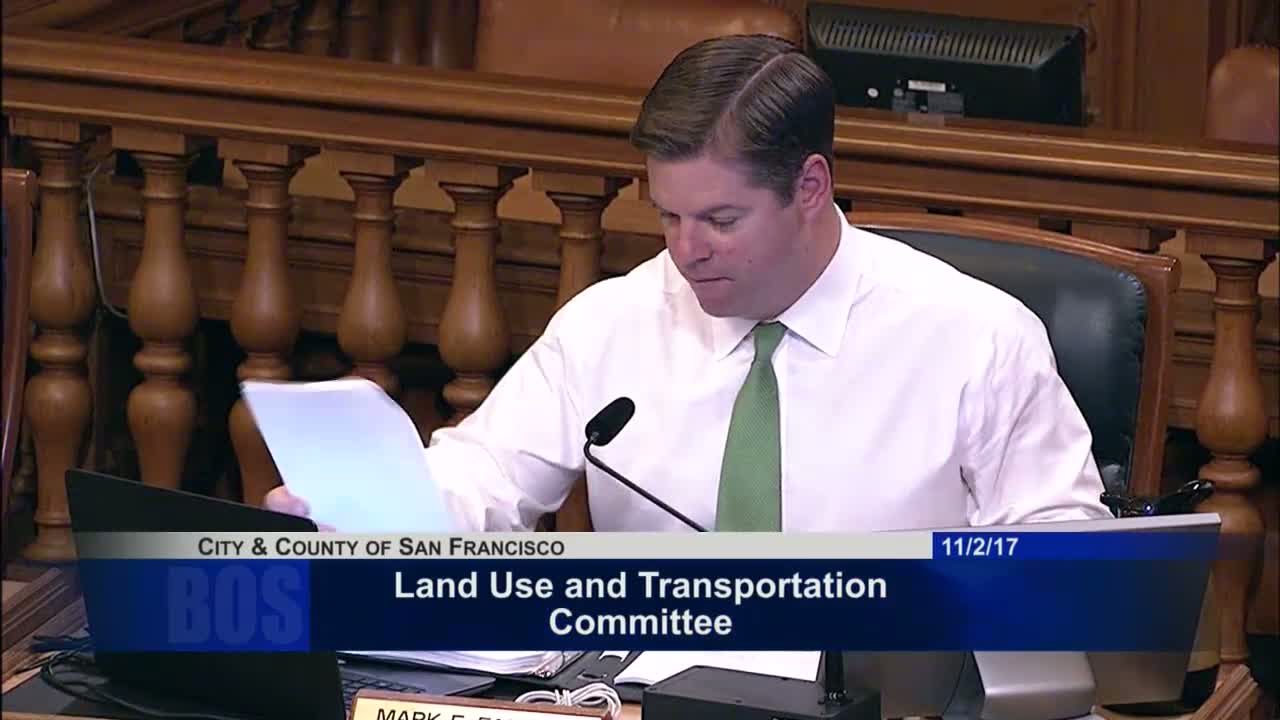
Chair Mark Farrell opened a special Land Use and Transportation Committee meeting to consider the planning-code changes after a lengthy public-comment period. The ordinance would regulate adult-use cannabis retail, medical cannabis dispensaries (MCDs), delivery-only services, manufacturers, cultivation and testing, and would repeal a previous ordinance that limited MCDs in District 11.
Supervisor Jeff Sheehy, the measure—o-sponsor, said the goal is to implement California—ivil Code Proposition 64 in a way that balances neighborhood concerns with access. "I believe that on January 1 we should capture adult use in the legal regulated system," Sheehy said, urging a conversion pathway for existing medical dispensaries and limited, phased access for pipeline applicants.
Planning staff presented the land-use framework and the Planning Commission—eedback, including a proposed 600-foot sensitive-use buffer around schools in the draft and an "ORBIT" alternative to an anti-clustering 300-foot rule. Aaron Starr of the Planning Department summarized district-by-district rules for retail, non-retail and conversion processes and said the planning commission favored retaining a 1,000-foot school buffer in its recommendation.
Public testimony filled much of the hearing. Residents from the Excelsior/Outer Mission (District 11) pressed to retain a cap on dispensaries in their commercial corridors and asked the board to exclude some neighborhood shopping-center (NC-S) geographies from retail authorization. Chinatown and many seniors and parents called for larger buffers and for childcare and daycare centers to be treated as "sensitive uses." Operators, equity advocates and business groups urged broader access to sites, a reduced buffer to support equity applicants and more on-site consumption options.
The Department of Public Health and the city nd health officer Dr. Thomas Aragon framed the policy question as a public-health trade-off: preserve San Francisco—lean-indoor-air standards while finding an incremental way to permit safer consumption sites. "The general public health consensus here is for us to be cautious as we move forward," Dr. Aragon said, noting the city im to balance indoor-air protections with novel adult-use policies.
Committee members adopted several technical changes and policy amendments on the record, many "without objection," and asked the city attorney to draft more detailed language for additional district-level changes on Monday. Notable committee actions included adopting language to restate limits on MCDs in the Excelsior/Outer Mission NCD and taking the Planning Commission pproach to clustering (the ORBIT/1,000-foot conditional-use trigger) as the baseline for further drafting.
Supervisor Katie Tang successfully moved to change the sensitive-use buffer number called out in the draft from 600 feet to 1,000 feet in the ordinance text under consideration; the committee recorded the motion as passing. The committee also asked staff to prepare additional options for districts that requested special treatment (including Chinatown and District 4) and to draft anti-speculation and conditional-use-abandonment language aimed at limiting landlord-driven displacement of incumbent operators.
Office of Cannabis staff reconciled counts and pipeline figures during the hearing: city staff reported 46 permits currently operating (including delivery), a larger universe of applicants in the pipeline (staff gave a broader count of roughly 62 depending on definitions), and seven applicants who would require land-use approval under the draft language.
The committee voted to continue the ordinance, as amended at the hearing, to the next Land Use Committee meeting on Monday so the city attorney and staff can prepare final, drafted amendments for formal committee action. Chair Farrell closed the meeting after supervisors agreed to the continuance.
Next steps: staff will supply written amendment language ahead of Monday's meeting; the committee expects to take up district-specific caps, childcare/daycare language for protected uses, CU-abandonment/anti-speculation options, and any remaining pipeline-grandfathering questions.