Get Full Government Meeting Transcripts, Videos, & Alerts Forever!
Get email alerts on the Central Soma Plan topic
No spam. Unsubscribe anytime.
Supervisors hear Central SoMa plan; planners defend jobs-heavy approach as residents warn of displacement
Summary
Planning staff told the Land Use & Transportation Committee that Central SoMa could yield about 40,000 jobs and 7,625 housing units and deliver more than $2 billion in public benefits; community groups and supervisors pressed officials for clearer timelines, identified sites for 1,080 promised affordable units, and stronger anti-displacement protections.
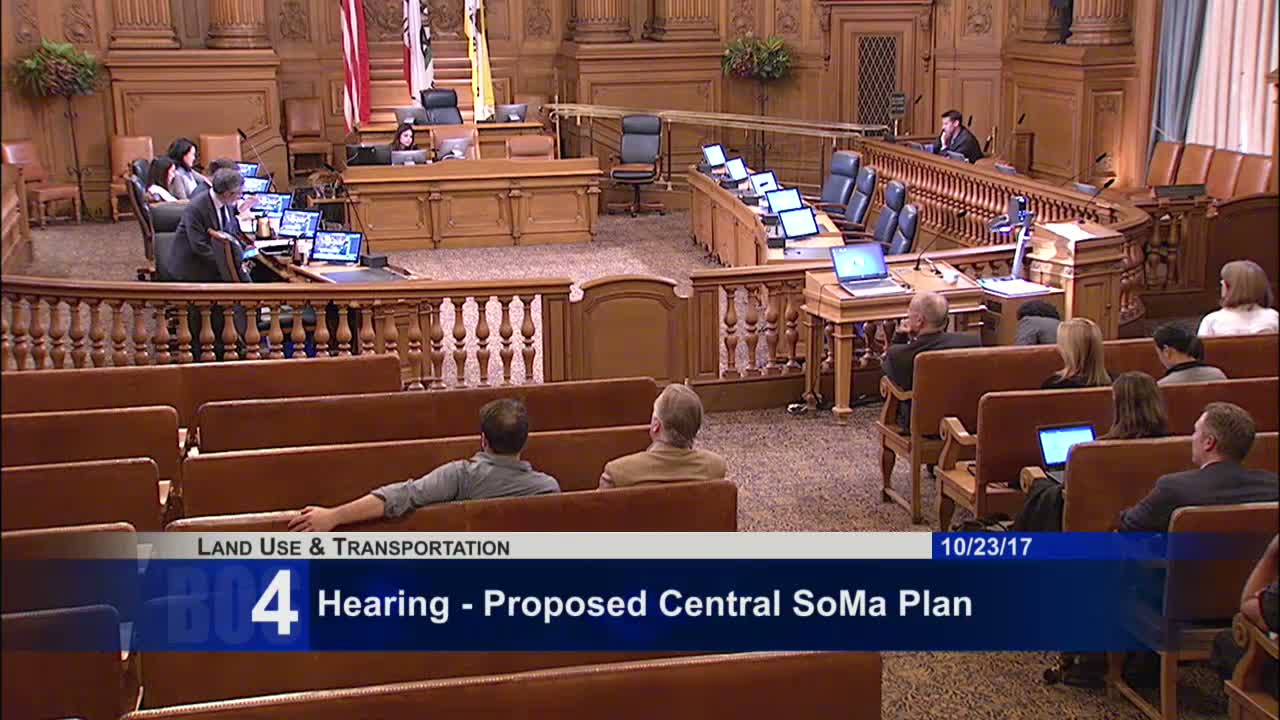
Planning staff presented the proposed Central SoMa area plan to the San Francisco Board of Supervisors Land Use and Transportation Committee on Oct. 23, describing the area as a transit-rich place that can accommodate job growth while contributing housing, parks and other public benefits.
John Ram, director of the Planning Department, said the plan began as an outgrowth of the Eastern Neighborhoods work and was intended to capture opportunities near the Central Subway and other regional transit. Steve Wertheim, the department’s project manager, told the committee the plan focuses on “horizontal density” across large parcels and outlined eight goals including accommodating jobs and housing, preserving cultural heritage and delivering parks and complete streets.
Wertheim said the plan envisions roughly 40,000 new jobs and 7,625 new housing units within the plan boundary. He told supervisors the plan could generate more than $2 billion in public benefits over a 25-year horizon—money that staff say would cover nearly $1 billion needed to reach a 33 percent affordable-housing target for the units counted inside the plan boundary, as well as substantial sums for transit, parks, PDR (production-distribution-repair) protections, and cultural preservation.
Multiple supervisors questioned a discrepancy between the plan’s unit total and a higher housing count in the draft environmental impact report (EIR). Wertheim and Ram said the EIR studied a larger study area that extended to Market Street and applied conservative assumptions; that geography and conservatism account for most of the difference, staff said. Supervisor Peskin pressed staff repeatedly on the arithmetic and on whether the plan, as written, would increase displacement pressures.
On affordable housing, Wertheim said staff expects 2,500 of the plan’s 7,625 units (33 percent) to be affordable: about 1,700 from inclusionary on-site requirements under Planning Code section 4.15, roughly 700 from jobs-housing linkage fees paid by nonresidential projects, and about 80 units on a city-owned Central Subway site at Fourth and Folsom. Staff also described partnerships and potential on-site affordable projects (including proposed developments involving TNDC, Tishman Speyer and others) and said the state density bonus and AB 73 could add more housing under certain conditions.
Amy Chan of the Mayor’s Office of Housing and Community Development said her office would coordinate to help reach the target and identify sites. Planning staff acknowledged that, as of the hearing, roughly 57 percent of the 2,500 affordable units had identified sites; about 1,080 affordable units remained without specific sites, a point that drew sustained questioning from Supervisor Kim and others. Staff and MOHCD identified some candidate parcels (including the Moscone-area garage site and other opportunities) and committed to continue site identification and preservation work.
Public commenters were divided. Business and property stakeholders including the Flower Mart and property owners said Central SoMa is an appropriate place for jobs and urged preservation of PDR uses. Neighborhood groups and housing advocates called for a mid-rise alternative (citing a 2013 plan), contended the EIR understates impacts or is confusing, and warned that rezoning and new height limits could accelerate displacement. Community groups urged clearer timelines for delivering affordable units, stronger preservation and acquisition strategies, and triggers tying infrastructure or public-benefit funding to development milestones.
Supervisors asked staff to return with more detail. Questions flagged for future hearings included: clearer mapping of the remaining 1,080 affordable units and any publicly owned parcels that could be used for 100 percent affordable projects; a breakdown of affordable units by area-median-income levels; how state laws such as SB 35 and AB 73 might affect entitlements; and whether triggers can be added to ensure infrastructure and community benefits are delivered as development proceeds.
The committee did not vote on the plan; staff said the EIR remains in circulation and the plan will undergo further Planning Commission and Board hearings before any legislation is introduced. The committee set additional hearings to follow up on infrastructure, open space and community benefits.