Get Full Government Meeting Transcripts, Videos, & Alerts Forever!
Get email alerts on the Behavioral Health Contracts topic
No spam. Unsubscribe anytime.
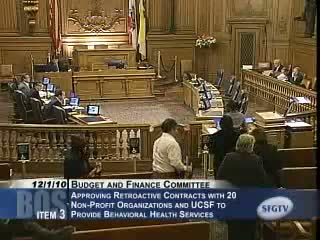
Committee forwards retroactive DPH behavioral health contracts amid questions on 12% contingency
Summary
The committee advanced retroactive behavioral-health service contracts totaling roughly $674 million (including a 12% contingency under discussion). Budget analysts recommended specifying contractors, amounts and annual reporting on the use of contingencies before Board approval; DPH defended contingency as administrative flexibility for COLAs, board add-backs and transfers among contractors.
The Budget & Finance Committee considered a package of retroactive contracts between the Department of Public Health and 19 nonprofit contractors and the University of California, San Francisco, covering community behavioral health services for the period July 1, 2010 through Dec. 31, 2015.
Budget analyst Harvey Rose summarized a lengthy review of the item, reporting that the department’s original submission totaled roughly $790.4 million and the revised amount for approval is approximately $674 million. The analyst noted that the package includes a 12% contingency for each contract (about $72 million in aggregate) and recommended that the resolution presented to the Board specify the revised totals without the 12% contingency, identify each contractor and contract amount, and require DPH to report annually on contingency usage.
DPH deputy financial officer Anna Kubo and other staff said the department concurs with the $674 million figure but argued the 12% contingency is a best-practice administrative tool cited by the nonprofit contracting task force to allow timely add-backs, COLAs and transfers where one contractor under-delivers. DPH said contingency authority is administrative and cannot be used without appropriation by the Board and that including the contingency avoids repeated contract modifications over the five-and-a-half-year contract period.
Supervisors questioned operational mechanics — whether the contingency represents a separate pot of money, how add-backs are handled, and what reporting and oversight would look like. DPH and OED staff agreed to language to require annual reporting that would allow the committee to see how contract amounts change year to year and whether contingency authority was used. Committee members accepted technical amendments and agreed to forward the contracts to the full Board with those amendments.