Get Full Government Meeting Transcripts, Videos, & Alerts Forever!
Get email alerts on the Mission Nct topic
No spam. Unsubscribe anytime.
Supervisors advance Mission Street zoning changes, interim storefront controls
Summary
The Land Use & Transportation Committee advanced permanent Mission NCT zoning changes to limit lot mergers, allow arts and catering uses, and protect ground-floor retail, and separately backed interim conditional‑use controls for large storefront mergers; committee sent both items to the full Board with positive recommendations after public comment about grandfathering and pipeline projects.
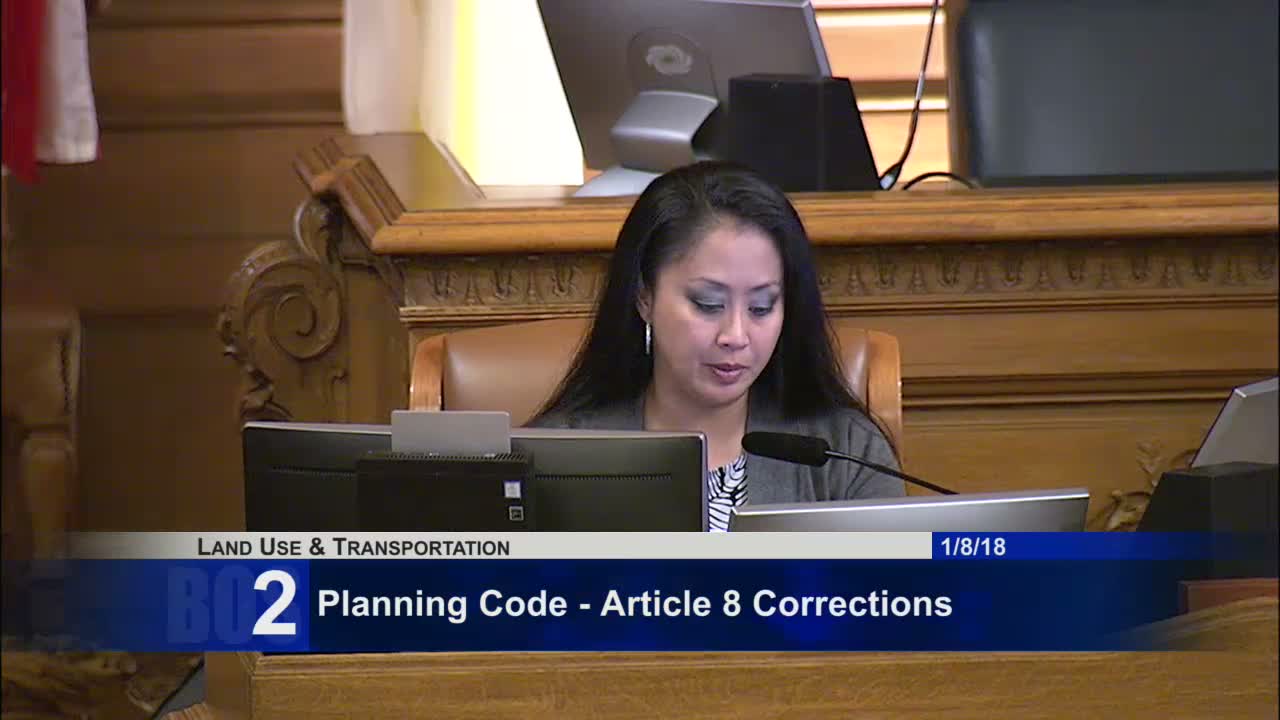
The San Francisco Board of Supervisors Land Use and Transportation Committee voted Jan. 8 to send to the full Board a package of changes aimed at preserving the pedestrian‑oriented character of Mission Street and protecting neighborhood‑serving ground‑floor storefronts.
Planning department staff said the amendments — drawn from the Mission Action Plan 2020 — would remove non‑retail professional services as a permitted use on Mission Street, permit arts activities and catering on all floors where compatible with neighborhood commercial uses, and limit lot mergers on Mission Street to projects with no more than 100 feet of contiguous street frontage to keep ground‑floor spaces smaller and more rentable.
Pedro Peterson, citywide planning staff, said the 100‑foot limit was the result of community negotiation after proposals ranged from 50 to 150 feet, and staff estimated the compromise would preserve opportunities for projects that provide a high percentage of below‑market‑rate (BMR) units while discouraging large ground‑floor consolidations.
Public commenters included Mark Loper, representing the sponsor of a 75‑unit mixed‑income project at 2918 Mission Street, who requested a narrow grandfathering clause to exempt projects that filed complete development applications before the ordinance’s effective date (he suggested 01/01/2018). Corey Smith of the San Francisco Housing Action Coalition warned against measures that might slow delivery of BMR housing and also asked that pipeline projects not be retroactively affected. Other neighborhood groups, including the Mission Economic Development Agency, supported restrictions on lot mergers and the addition of arts and catering uses as ways to stabilize the corridor and create space for cultural and small businesses.
Committee members asked legal staff to confirm the text of the legislative digest and to review the grandfathering question. Deputy City Attorney John Givner said a corrected digest had been filed in the clerk’s file that morning, and supervisors encouraged the project sponsor and counsel to confer offline about whether state entitlement protections already apply.
Separately, the committee supported a resolution to continue interim controls and require conditional use authorization for proposed restaurant conversions and commercial storefront mergers that would create spaces over 2,000 square feet in a defined Mission‑area zone. Amy Beinart, legislative aide to a sponsoring supervisor, said the interim measure would provide immediate protection for commercial diversity while a broader retail‑use review and related legislation proceed.
Both the Mission NCT amendments and the interim storefront‑merger controls were moved to the full Board with positive recommendations and no recorded objections. The full Board will consider both items in subsequent hearings; any grandfathering amendments or technical changes would need to be filed and vetted before that hearing.