Get Full Government Meeting Transcripts, Videos, & Alerts Forever!
Get email alerts on the Environment Bottle Free topic
No spam. Unsubscribe anytime.
Committee forwards expanded ‘bottle‑free’ ordinance to full board, asks staff to refine language
Summary
The Public Safety & Neighborhood Services Committee voted to forward an ordinance that would expand San Francisco’s 2014 bottle‑free law to include packaged water (boxes, bags and other single‑use containers), strengthen enforcement and increase tap‑access funding, while directing staff to refine language on size limits and waiver authority.
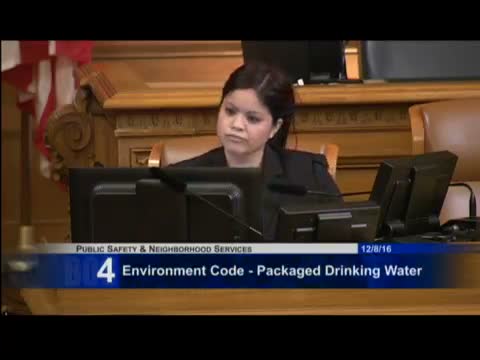
The Public Safety and Neighborhood Services Committee on Dec. 8 voted to forward to the full Board an ordinance that would broaden San Francisco’s existing bottle‑free policy to cover packaged water beyond single‑use plastic bottles and to strengthen enforcement and departmental accountability.
Sponsor Supervisor Eric Marr told the committee the ordinance is designed to “update and strengthen and close loopholes on a plastic water bottle free ordinance that we passed in 02/2014,” and to promote reusable containers and expanded access to municipal tap water.
The measure would amend Chapter 24 of the Environment Code to limit sales and distribution of single‑service packaged water on city property, expand the types of packaging covered (including boxed and aseptic packages), and create clearer education and accountability responsibilities for departments.
John Scarpulla of the San Francisco Public Utilities Commission, who leads the city’s Drink Tap program, described installation and usage figures the PUC provided as the ordinance moved forward: the PUC has installed 82 drink‑tap sites citywide (31 in the public realm and 51 at schools), 21 public stations have been installed since the original 2014 policy, and another 21 public stations were funded and scheduled for installation by March 1, 2017. Scarpulla said stations were sited to prioritize neighborhoods with high consumption of sugar‑sweetened beverages and environmental‑justice communities and that metered stations can quantify plastic‑bottle reductions.
Jack Macy of the Department of the Environment said his office supports broadening the code to include packaged water but asked the Board to consider expanding the proposed 1‑liter cap to a larger limit (he suggested up to 5 gallons) to address agency and event uses. Macy also raised capacity concerns about assigning permitting and waiver authority and recommended coordination between the Department of the Environment and the SFPUC on water infrastructure access and guidance.
Environmental and conservation groups urged stronger language. Paul Ledesma of Save the Bay said the closure of loopholes and public‑tap reporting would strengthen progress on reducing marine debris. Eva Holman of Surfrider San Francisco said closing the packaging gap would reduce the number of plastic water bottles collected at beach cleanups. Corporate Accountability International and the Sierra Club also testified in support.
Committee members debated whether the ordinance should regulate packaged water of any size or retain a 1‑liter limit. Supervisor Marr asked staff to work with the Department of the Environment and the SFPUC and to return substitute language for the full Board hearing. The committee voted to forward the ordinance with a positive recommendation while the sponsor’s office and staff agreed to prepare refined language and possible amendments for the Board’s consideration.
The committee’s vote was procedural: the ordinance will be considered by the full Board at the scheduled meeting (listed on the committee agenda as the Dec. 13 board meeting).