Get Full Government Meeting Transcripts, Videos, & Alerts Forever!
Get email alerts on the Ocean Beach Safety topic
No spam. Unsubscribe anytime.
City and federal agencies report stepped-up patrols, signage and coordination after Ocean Beach drownings
Summary
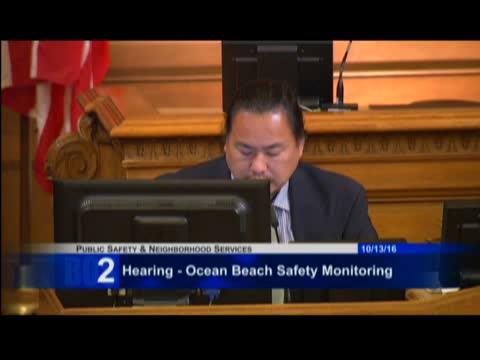
Following several drownings at Ocean Beach, National Park Service, San Francisco Fire Department, Coast Guard and city emergency managers reported expanded beach patrol hours, refreshed signage, public outreach and improved cross-agency communications; committee filed the hearing and asked partners to continue coordination.
San Francisco supervisors heard updates on Ocean Beach safety at a follow-up hearing six months after two teenagers drowned. The hearing emphasized prevention measures, interagency coordination and public information to keep casual visitors out of the water.
Howard Levitt and Deputy Chief Ranger Chad Marin of the National Park Service reported that since the last hearing beach patrols have logged thousands of hours and made more than 10,000 safety-prevention contacts; park teams also conducted rescues and coordinated more closely with the San Francisco Fire Department and Coast Guard. "The secret is keeping people out of the water," Levitt said, stressing outreach and signage as primary tools.
Cecile Serra of the Department of Emergency Management said dispatch and CAD improvements and new "super codes" speed multi-agency responses for surf incidents. San Francisco Fire Department Public Information Officer Jonathan Baxter described increased joint public-service announcements, Spanish-language outreach and integrated communications with partner agencies. Commander Matthew Thompson of the U.S. Coast Guard reiterated that Ocean Beach is unusually hazardous — cold water and strong rip currents that often leave little time to effect a rescue.
Officials described a four‑pronged strategy: better, multilingual signage and seawall numbering to speed 911 responses; strengthened interagency cooperation; improved search-and-rescue coordination and training; and public education and targeted outreach on hot days. The National Park Service also plans biannual refreshes of seawall location numbers and is exploring volunteer public-information crews for high‑visitation days.
The committee moved to file the hearing without objection and asked agencies to continue implementation and coordination of prevention, signage and rapid-response measures.
Next steps: agencies will continue signage updates, staged staffing tied to weather and visitation, coordinated public-service announcements, and ongoing interagency training.