Get Full Government Meeting Transcripts, Videos, & Alerts Forever!
Get email alerts on the Police Accountability topic
No spam. Unsubscribe anytime.
Rules Committee hearing on police commission nominations draws hundreds of callers and sharp divides
Summary
The Rules Committee heard extensive testimony, questioned nominees Nancy Tung and Jeffrey Gordon Creed about police reform, DOJ recommendations and local cases, and then amended and forwarded both nominations to the full Board amid heavy public opposition and strong pockets of support.
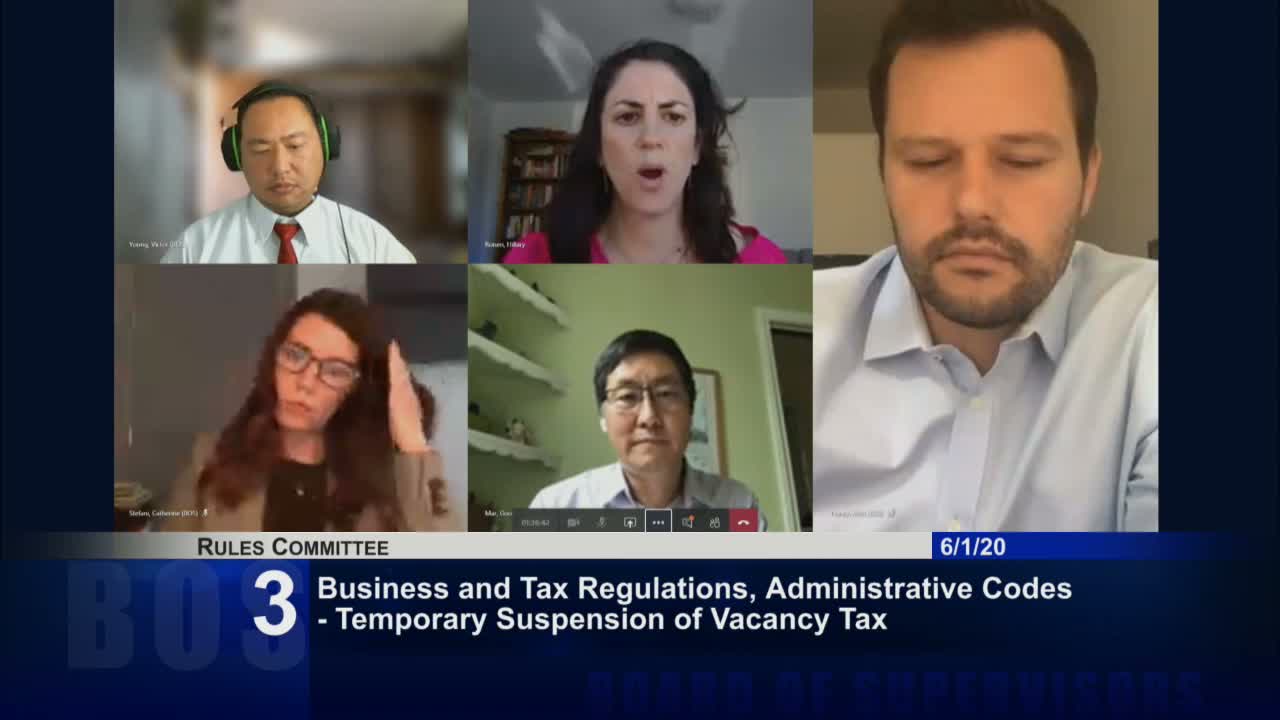
The San Francisco Rules Committee spent the bulk of a multi‑hour remote meeting on two mayoral nominations to the Police Commission — Nancy Tung (nominee name spelled variously in the record) and Jeffrey Gordon Creed. The hearing featured extended opening remarks from Chair Supervisor Hillary Ronan and other supervisors, detailed questioning of both nominees, and more than 100 callers during an extended public‑comment period that reflected deep disagreement across the city.
Chair Ronan framed the hearing in the context of national protests over police killings, citing George Floyd and others, and said the Board has an urgent responsibility to nominate commissioners who will accelerate police‑reform work and implement recommendations from the U.S. Department of Justice. She asked the nominees to answer a series of direct yes‑or‑no questions and said she expected the committee to create a clear record for the full Board.
Nancy Tung, a career prosecutor who has worked on cases involving police misconduct, told the committee she would champion implementing DOJ reforms and emphasized her prosecutorial experience, including a noted instance when she declined to pursue cases tainted by flawed evidence. Tung said she had previously supported arming officers with tasers but had recently revised that position given community distrust. She described plans to require public reporting on reform timelines and to press the chief and working groups to return discipline‑related Department General Orders to the commission with concrete deadlines.
Jeffrey Gordon Creed, a longtime civil litigator and former city attorney staffer, said his career has given him experience with municipal procedure, hearing evidence and resolving disputes; he pointed to his board service with the YMCA and other community work as evidence of his community engagement. Creed said the most important remaining reforms are addressing institutional bias and the department’s use‑of‑force policy, and he emphasized culture change and accountability as implementation priorities.
Public comment ran more than three hours. Speakers included neighborhood groups and many residents who urged opposition to both nominees, arguing that Nancy Tung’s prior positions — including early support for a ballot measure that would have limited the commission’s ability to regulate taser use, opposition to ending cash bail and opposition to the board’s juvenile‑hall deadline — and her campaign contributions from some police officers create conflicts of interest. Many callers said the moment demanded commissioners with a long, demonstrable track record in police‑reform movements and who unequivocally support prosecuting officers in local lethal‑force cases. Other callers — including several Chinese‑American civic groups, business leaders and neighborhood advocates — urged the board to confirm Tung, citing the need for Asian‑American representation on the seven‑member commission and praising her prosecutorial experience.
After closing public comment, the committee debated and then amended the staff motions: members removed the word “approving” from draft motions and forwarded both nominations to the full Board with the amended language. Roll‑call votes on the amendments passed with Supervisor Catherine Stephanie dissenting; Supervisors Gordon Marr and Hillary Ronan voted aye on both amendments.
The full Board will now consider the nominations at a future meeting. The hearing produced a detailed public record of differing community expectations for police oversight at a moment of national urgency over policing and racial justice.