Get Full Government Meeting Transcripts, Videos, & Alerts Forever!
Get email alerts on the Revenue Measures Roundup topic
No spam. Unsubscribe anytime.
Board committee advances and amends package of proposed November revenue measures after hours of presentations and public comment
Summary
Supervisors reviewed a suite of revenue measures for the Nov. 2, 2010 ballot — Supervisor Chu’s business‑tax reform (progressive payroll structure, $1,500 credit, phased commercial rent tax), a hotel‑tax initiative to close online-travel-company loopholes, a proposed transfer-tax increase targeted at high‑value sales, and a 10‑point parking‑tax increase — accepted amendments to the business package and continued several items for further analysis.
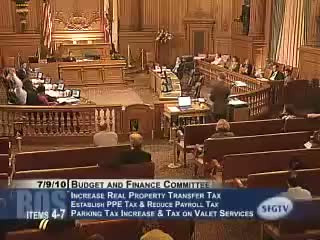
The Budget & Finance Committee devoted most of its July 1 meeting to a set of proposed revenue measures being considered for the November ballot, including Supervisor Chu’s business‑tax reform, a hotel‑tax initiative from the mayor, a revised real property transfer tax, and a parking‑tax increase.
Supervisor Chu presented a business‑tax reform package that (as introduced) would cut payroll-tax burdens for many businesses by creating a progressive payroll‑tax structure (with a lower rate for wages under $85,000), provide a $1,500 standard credit for payroll taxpayers, and impose a phased commercial rent tax to broaden the taxpayer base. Ted Egan of the Controller’s Office presented an economic analysis: in the original proposal, revenue and job effects varied by year and sector, with initial revenue estimates discussed in the hearing in the range of $34 million (original estimates) and projected amended estimates of about $28 million depending on exclusions and thresholds. The Controller showed that, under the amended package Supervisor Chu proposed at the hearing (including a $65,000-per‑year small‑tenant exclusion and lower rent rate), the proposal would both raise revenue and produce modest private‑sector job growth over a 20‑year horizon according to the Controller’s model.
Supervisor Avalos and others said the committee would consider Chu’s amendments and requested that the Controller return with re-run pro formas reflecting the proposed changes. The committee voted to accept the amendments to the whole and to continue Items 5–7 to the next hearing (scheduled July 14) so that updated economic analysis and collection/enforcement data could inform decisions.
Separately, the clerk read Item 4, the mayor’s hotel‑tax initiative. Greg Wagner (mayor’s budget director) described two objectives: (1) close a perceived loophole in which online travel companies pay hotel tax on wholesale rates rather than market rates and (2) clarify the thirty‑day permanent‑resident exemption applies to individuals, not businesses. Wagner estimated the hotel‑tax clarification would generate about $6 million in FY 2010–11 and roughly $12 million annually thereafter. Supervisors questioned Section 4 of the mayor’s initiative, which could affect the interaction of competing hotel‑tax measures on the same ballot, and Deputy City Attorney Cheryl Adams reiterated that the Board’s role in an initiative filing is informational and that the Board cannot amend an initiative after it has been filed with the Department of Elections.
Supervisor Avalos also described amendments to a proposed real property transfer tax that would limit increases to higher thresholds: properties sold for more than $5 million would see a rate rise from 1.5% to 2.0%, and sales above $10 million would face a 2.5% rate, with projected additional revenue of roughly $25 million a year per the sponsor’s estimate — the Controller said he would return with updated estimates for the amended thresholds.
Supervisor Mercarimi (parking tax sponsor) proposed raising the private parking tax rate (including surcharges) from 25% to 35% and imposing a gross‑receipts tax on valet parking. The Controller’s analysis projected parking‑tax revenue of roughly $17–20 million per year after accounting for some behavioral reduction in parking demand; the MTA and treasurer’s office testified in support, while parking‑industry representatives, unions and business groups warned about potential job and retail impacts and asked the City to first pursue audits and stronger enforcement against underreporting.
Public comment ranged widely: tenant‑advocacy and social‑service groups urged progressive revenue to preserve services; parking‑industry speakers and unions warned about jobs and enforcement; business and property groups warned about job loss and volatility of tax bases. The committee took amendments on the business package, asked for updated controller analyses, and scheduled continuation of the transfer‑tax, payroll/commercial‑rent, and parking measures to July 14 for further review.
Next steps: the Controller will re-run pro formas for amended business‑tax language; the committee will revisit Items 5–7 on July 14 with updated fiscal/collection analysis and the chair’s recommended configurations.