Get Full Government Meeting Transcripts, Videos, & Alerts Forever!
Get email alerts on the Real Estate Transfer Tax topic
No spam. Unsubscribe anytime.
Supervisors advance proposal to raise transfer tax on high‑value San Francisco properties to ballot
Summary
A proposed amendment would create two new higher transfer‑tax brackets for sales above $5 million and $10 million, projected to generate an average $35 million a year; the Budget and Finance Committee forwarded the measure to the full Board of Supervisors without recommendation after a controller’s office impact briefing and public comment.
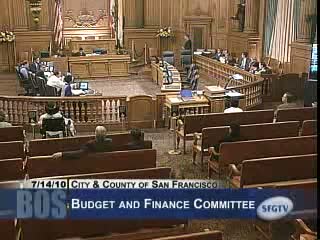
Chair John Avalos brought the proposed amendment to the real property transfer tax before the Budget and Finance Committee and said the measure would target high‑value sales while leaving single‑family homeowner rates unchanged. The proposal would create a new bracket for property sales between $5 million and $10 million taxed at 2% (up from 1.5%) and a bracket for sales over $10 million taxed at 2.5% (up from 1.5%).
Ted Egan, chief economist in the controller’s office, summarized an economic impact report and said, “If you average the experience over the past 9 years, the average revenue gain for the city is $35,000,000,” while noting actual annual receipts could vary widely (Egan cited a historical range of roughly $6 million to $90 million depending on market activity). He told supervisors the increases would largely fall on commercial office properties and that owners would likely attempt to recoup some of the cost through higher rents.
Supervisors questioned the incidence and competitiveness effects. Supervisor Maxwell asked whether landlords would recoup the tax by raising rents; Egan said landlords would try to shift costs to tenants and that cross‑jurisdiction relocation would depend on relative tax policies and land values. On employment impacts, Egan said the model projects modest private‑sector job reductions in later years (on the order of a few hundred jobs annually at most) and emphasized that the effect is small relative to the city’s total payroll employment.
Public commenters voiced mixed views. Otto Duffy, a District 6 neighborhood activist, argued that wise public spending can create jobs and called the long‑term “doomsday” framing uncertain. A member of the public, Walter Pulsen, voiced general support for the transfer tax in a less structured comment.
The committee did not adopt an endorsement; by motion the item was forwarded to the full Board of Supervisors without recommendation for final consideration and potential placement on the November 2, 2010 ballot. The measure will be considered at the full board meeting where any final changes and the decision to place it before voters will be made.