Get Full Government Meeting Transcripts, Videos, & Alerts Forever!
Get email alerts on the Inclusionary Housing topic
No spam. Unsubscribe anytime.
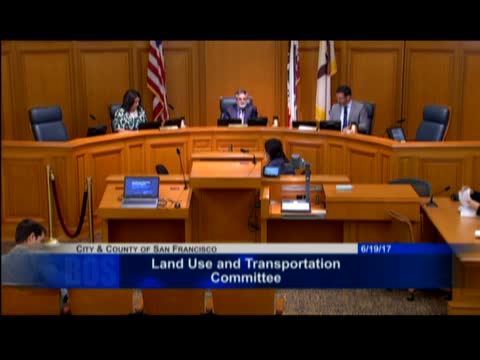
Land Use Committee introduces amendments to inclusionary housing ordinance; material change sent back to Planning Commission
Summary
The Land Use & Transportation Committee on June 2017 introduced a package of amendments to San Francisco's inclusionary housing rules—adjusting fee-setting processes, unit mix and size rules, and Transbay provisions—and sent a material modification (section 207.7) back to the Planning Commission while forwarding a version of the file to the full Board without that section.
Acting Chair Aaron Peskin introduced a set of amendments to the city’s inclusionary affordable housing ordinance and moved the package forward to the full Board while referring a material modification back to the Planning Commission.
The amendments—read into the record by Deputy City Attorney Kate Stacy and summarized by Jacob Bentley of the Planning Department—cover allocation of on‑site units by income tier in certain eastern neighborhoods, updates to fee‑setting procedures, changes to unit‑size standards, new rules for replacement of demolished affordable units, and Transbay‑specific provisions requiring on‑site units and AMI caps.
Why it matters: the committee’s action keeps most of the negotiated changes on track for Board consideration while pausing a disputed subsection so the Planning Commission can review technical material modifications. That matters to developers, affordable‑housing advocates and neighborhood stakeholders who have sought clarity on how fees, unit mixes and geographic rules apply to new projects.
The committee heard recommendations from the Planning Commission, as presented by Jacob Bentley of the Planning Department. Bentley said the commission identified six material modifications and multiple technical clarifications. Key commission suggestions included embedding a dwelling‑unit mix requirement (for example, ensuring a minimum share of three‑bedroom units within the total required BMR units), referencing California Tax Credit Allocation Committee (TCAC) statewide minimums for unit sizes rather than fixed numbers, and removing a prohibition that would concentrate low‑income households into studio units.
On the fee question, Bentley noted the draft’s proposed fee rates (30 percent for rental and 33 percent for condominium projects) exceed the maximum feasible amounts identified in the controller’s earlier study. He told the committee the commission recommended that the Technical Advisory Committee (TAC) and the Controller’s Office analyze fee methodology and that the TAC reconvene to set an updated fee by the end of the study period (the commission recommended studying methodology and reporting back by January 2018). "Those are higher than the maximum feasible amount from the controller study," Bentley said, and the commission asked TAC and the controller to study the methodology used to set the fee.
Deputy City Attorney Kate Stacy summarized the drafting changes in the ordinance text: clarifications on when different inclusionary requirements apply in Eastern Neighborhoods, North of Market and SoMa; a proposed on‑site allocation for rental projects in those districts (15 percent low income, 5 percent moderate, and 5 percent middle income); replacing numeric minimum square‑foot standards with TCAC sizes and a 300‑square‑foot minimum for studios; a proposed rule that certain properties be made affordable for the life of the project (rather than a 55‑year term); and a requirement to replace on‑site affordable units lost to demolition or removal.
Stacy also described provisions affecting on‑site alternatives and studio units: the draft would prohibit studio units from counting toward required affordable units when sales prices or AMI thresholds exceed specified levels, and it would cap studios at no more than 30 percent of proposed dwelling units in new construction; the committee identified that studio limits and related mixed‑use exclusions (captured in section 207.7) are material modifications that warrant Planning Commission review.
Transbay area rules were discussed as a technical exception: the Office of Community Infrastructure and Investment (OCII) and Planning Commission staff recommended that Transbay’s redevelopment rules remain consistent with the Transbay redevelopment plan and state law, applying the higher redevelopment percentage or the citywide inclusionary rate as appropriate, requiring on‑site units (not off‑site or fee alternatives), and setting condo caps at 100 percent AMI and rental maximums at 60 percent AMI.
On procedure, Deputy City Attorney Givner advised that because subsection 207.7 contains a material modification it should be referred back to the Planning Commission. The committee agreed to duplicate the file: a version without section 207.7 will be forwarded to the full Board with a recommendation, while the Planning Commission will review the 207.7 changes separately. The Planning Commission hearing was confirmed for early July 2017; committee members set a continuation to the Board meeting of July 10, 2017 for the duplicated file.
Public comment was briefly reopened; Dean Preston asked whether the original geographic language would remain intact when the June 2017 date was reverted. Peskin confirmed that the only substantive change in that passage was the date reversal to "01/01/2015" and that the original language otherwise remained.
The committee then moved, seconded and, "without objection," adopted the amendments as described by Stacy and the date change on page 29, line 1, to 01/01/2015. The committee voted to forward the duplicated file to the full Board without section 207.7 and to continue the duplicated file to the Board meeting of July 10, 2017. The committee adjourned thereafter.
What’s next: the Planning Commission will formally review the material changes in section 207.7 at its scheduled hearing; the full Board will receive the version of the ordinance that omits 207.7 for its consideration on the schedule already set by the Clerk.