Get Full Government Meeting Transcripts, Videos, & Alerts Forever!
Get email alerts on the Inclusionary Housing topic
No spam. Unsubscribe anytime.
Supervisors advance amended inclusionary housing compromise, continue discussion on HomeSF linkage
Summary
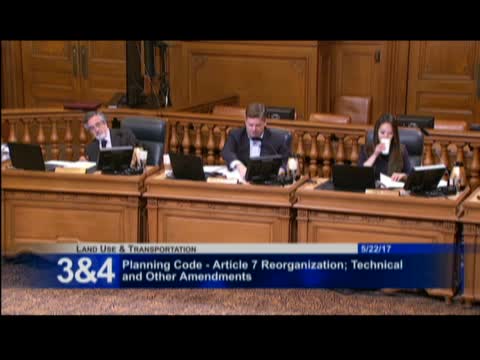
After two weeks of negotiations, supervisors presented a compromise on inclusionary housing rates, AMI targeting and grandfathering; the Planning Department and Controller reviewed feasibility analyses, and the committee accepted amendments and continued items to allow City Attorney refinements and further public review.
The committee considered two linked items (5 and 6) revising the inclusionary affordable housing program and adding reporting requirements.
Supervisor Aaron Peskin described intensive negotiations with multiple sponsor offices and city staff to find an approach "within the bounds of the fiscal feasibility study" that could win broad support. Supervisors Safai, Tang, Kim and others said they were close to agreement on AMI bands, percentages and indexing; they asked the City Attorney to finalize clean language for public posting before the next committee meeting.
Planning Director John Ram and department staff (Jacob Bentliff) summarized the Planning Commission recommendations, the history of the inclusionary program (established in 2002 and responsible for roughly 4,600 affordable units), and the Commission's technical suggestions: tiered AMI targeting, schedule of annual increases with a 24‑month delay before increases begin, maximum caps for eventual rates (example: up to 23% on‑site for rentals and up to 28% fee equivalent for condominiums), and proposals to assess the affordable housing fee on total residential square footage. Planning staff noted potential grandfathering questions for projects in the pipeline.
Controller office analyst Ted Egan presented highlights from the financial feasibility report: the study modeled feasible ranges (e.g., 14–18% on‑site for rental projects in certain scenarios) and used two modeling approaches (sample project pro‑formas and a citywide statistical model). Egan summarized trade‑offs: some proposals would produce more overall housing but fewer deep‑affordable units; depending on the package, the city could see increases in housing production and small changes in housing prices, while other proposals could reduce affordable units by several percentage points.
Public comment included a broad set of stakeholders: building trades and unions urged the compromise to serve "the missing middle" (workers who do not qualify for deep-subsidy programs), tenant and neighborhood groups urged reconciling inclusionary rules with HomeSF (local density bonus) and warned that decoupling HomeSF could erode low‑income outcomes, and others urged clearer grandfathering rules. Several speakers called for continuing the item so the public can review the finalized amendments and the HomeSF linkage.
Committee action: Supervisors moved to adopt the negotiated amendments, have the City Attorney finalize language within 24 hours and post it for public review, and continue the items for two weeks. Item 5 was tabled to allow further work; the sponsors said they would return with a clean package and the Controller would provide updated analysis if requested.
What happens next: City Attorney to post finalized amendments, Controller/Planning to provide any requested follow‑up analysis, and the committee will revisit the items at the next scheduled Land Use meeting.