Get Full Government Meeting Transcripts, Videos, & Alerts Forever!
Get email alerts on the Affordable Housing topic
No spam. Unsubscribe anytime.
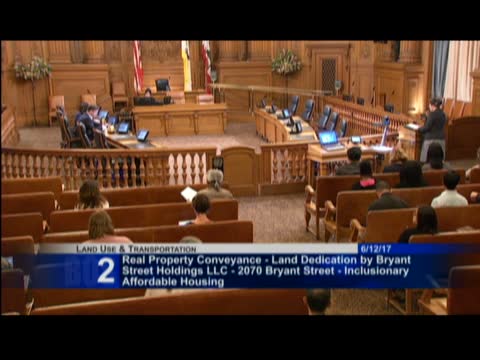
Board committee backs land dedication at 2020 Bryant to speed affordable housing in Mission
Summary
The Land Use & Transportation Committee recommended forwarding a resolution authorizing conveyance of a roughly 19,000-square-foot parcel at 2020 Bryant Street to support a 130-unit affordable housing project; the transfer is conditioned on environmental remediation steps, a roughly $1 million escrow deposit and pollution insurance. Supervisors asked for more detail on contamination and appraisal adjustments.
The San Francisco Board of Supervisors Land Use & Transportation Committee on Monday recommended forwarding a resolution that would authorize the city to accept a roughly 19,000-square-foot parcel created as part of the 2000 Bryant Street mixed‑use development and dedicate it for an affordable housing project.
Lydia Ealy, senior project manager at the Mayor’s Office of Housing and Community Development, told the committee the transfer is part of the inclusionary‑housing obligations of the larger 2000 Bryant market project and is conditioned on the creation of a new parcel, deposit into escrow of about $1,000,000 to cover future remediation, and purchase of pollution insurance required by the city’s risk manager. She said the market‑rate project appraised at $21,200,000 and MOHCD has selected a development team led by Tenderloin Neighborhood Development Corporation and Mission Economic Development Agency to build a roughly 85‑foot, eight‑story building with about 130 family units affordable at 60 percent of median income.
Supervisor Aaron Peskin and other committee members pressed staff for technical detail about the site’s contamination, including whether the groundwater plume under the site extends to neighboring parcels and what contaminants are present. Ealy said some contamination is in groundwater, which constrains the timing of certain mitigation measures and often requires installation of a ‘‘liquid boot’’ or vapor barrier tied to the project’s design; she also said the city had conservatively assumed hauling all site soil out of state in its cost estimate and added a 15 percent contingency after third‑party review.
Deputy city attorneys explained the purchase agreement includes an "as‑is" clause in Section 8.3 but that representations and warranties from the seller (Section 8.1) were negotiated and the city is taking the property "as we know it" subject to those seller representations, including the seller’s commitment to escrowed remediation funds and pollution insurance.
Committee members said they supported moving the item forward; Supervisor Tang moved the committee recommendation and it was approved without objection.
The committee asked staff to provide the precise contaminant characterization and to confirm whether the appraisal adjusted for environmental remediation costs. Staff said the appraisal did not incorporate remediation adjustments because the agreement addresses those costs separately through escrow deposits and indemnities.