Get Full Government Meeting Transcripts, Videos, & Alerts Forever!
Get email alerts on the Memorial Resolution topic
No spam. Unsubscribe anytime.
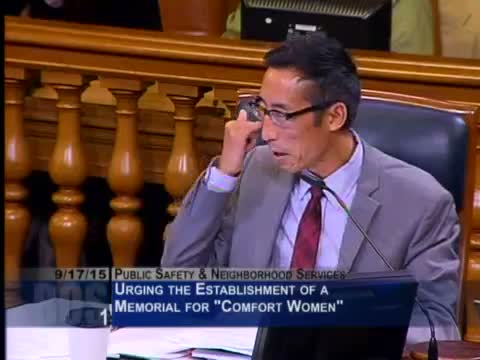
San Francisco committee advances resolution to establish ‘comfort women’ memorial after hours of testimony
Summary
The Public Safety and Neighborhood Services Committee advanced a resolution urging the City and County of San Francisco to establish a memorial honoring wartime "comfort women," after nearly four hours of public comment that featured survivors’ testimony, academic and faith‑community endorsements, and testimony from opponents who warned of community division and questioned some historical claims.
The Public Safety and Neighborhood Services Committee voted to send a resolution to the full Board of Supervisors recommending the establishment of a memorial to women who say they were forced into sexual servitude by the Japanese Imperial Army during World War II.
Chair Eric Marr opened the hearing by calling it "a historic day in these chambers" and introducing Halmony ("Grandma") Lee, a survivor who traveled from Korea to testify. In brief remarks, Marr framed the proposal as an effort to "break silence," honor survivors and to create educational resources for future generations.
Survivor testimony anchored the hearing. "We hate the crimes, but not the people," testified Yong Soo Lee, identified in the record as a surviving witness who urged an official apology and reparations from the Japanese government and asked the city to erect a memorial while a small number of survivors remain alive.
Supporters at the hearing — including interfaith leaders, scholars, survivors’ advocates and community groups — described the proposed memorial as an educational tool and a means to prevent modern human trafficking. Academic speakers and human‑rights advocates cited estimates and scholarship that characterize the wartime system as large in scale and punitive; several witnesses linked memorialization to broader work on women’s rights.
Opponents, including leaders and residents in the city’s Japanese American community and speakers who identified themselves as Japanese or Japanese American, urged delay or changes. Speakers raised concerns that the existing draft language could inflame anti‑Japanese sentiment, argued the matter touched on international diplomacy, and cited research they said casts doubt on specific factual claims (including references to a U.S. interagency report discussed in testimony). Some opponents pointed to disruptions in other cities (notably Glendale) and warned of backlash affecting schoolchildren and local commerce.
Committee debate focused on process more than design. Chair Marr said there were no set plans for the memorial’s design or location and said he intended to involve Japanese American leaders and other stakeholders in further development. After public comment, a committee member moved to advance the resolution with a positive recommendation; staff confirmed the item would be transmitted as a committee report to the full Board of Supervisors for consideration on the Board docket (the clerk noted a September 22 Board date), and the motion carried without objection.
What’s next: The resolution will appear on the full Board of Supervisors’ agenda as a committee report. No site, design, or task‑force membership was finalized at the committee hearing; several speakers asked that any development process include broad outreach to Japanese American community leaders and other stakeholders before plans are finalized.