Get Full Government Meeting Transcripts, Videos, & Alerts Forever!
Get email alerts on the Policing Bias topic
No spam. Unsubscribe anytime.
Supervisors press for broader bias training, data and DA review after SFPD texting scandal
Summary
On June 18 the Board's Public Safety Committee heard departmental updates and community demands for mandatory bias training, public stop data and a review of prosecutions tied to officers who sent racist and homophobic text messages; the committee filed the bias hearing and continued related jail deliberations.
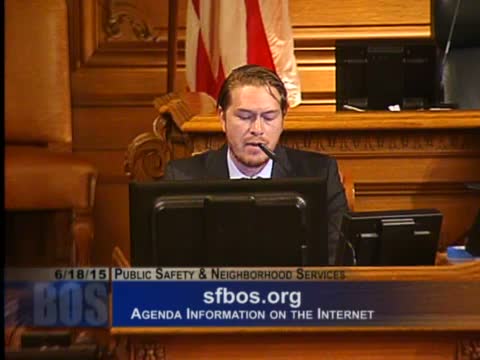
San Francisco ' On June 18, 2015 the San Francisco Board of Supervisors' Public Safety and Neighborhood Services Committee heard updates from the Public Defender's Office, San Francisco Police Department (SFPD), the Office of Citizen Complaints (OCC) and the District Attorney's office on bias within the criminal-justice system and on steps the city is taking to respond.
Chair Eric Marr opened the session by placing racial disparities at the center of the discussion, noting that "6% of San Francisco residents are African American and 56% of the inmates in our jails are African American," and calling for improved data collection, training and accountability across agencies.
San Francisco Public Defender Jeff Adachi presented a multi-point reform proposal developed by his office's Bridal Justice Committee. The plan advocates set-hour implicit-bias training for officers (Adachi discussed "24 hours" as a target), routine reviews of field-training officers, quarterly public reporting of use-of-force logs, limits on school arrests and expanded mental-health crisis response. Adachi said SFPD has provided some implicit-bias training but argued for a citywide standard and broader implementation.
Deputy Chief Mikhail Ali, who is assigned to SFPD's administration bureau, updated the committee on the department's response. He said the internal investigation into officers who sent racist and homophobic text messages is on hold after nine officers petitioned the Superior Court to stay disciplinary proceedings; the court granted a temporary stay and a hearing was set for the coming Monday to determine whether the court will take jurisdiction. "We are required to comply with confidentiality requirements," Ali said, and added that the officers were suspended with pay and not on patrol.
Ali described training already delivered to SFPD command staff by an outside expert and said the department plans to issue a request for proposals to identify local trainers for broader implicit-bias work. On data collection, he said the department is pursuing technology to capture real-time demographic information about all stops and field interviews to allow faster reporting to the public.
Joyce Hicks, director of the Office of Citizen Complaints, told the committee the OCC is asking the mayor and board for restored positions in the proposed budget, listing a 0.25 attorney adjustment, a senior investigator and IT support; she said OCC investigators currently carry roughly 28 cases each and that the public is dissatisfied with case follow-up.
Christine Souto DeBerry, chief of staff to District Attorney George Gascf3n, said the DA's office launched a task force and asked retired judges to review thousands of arrest reports tied to implicated officers. DeBerry said the DA's office was reviewing 1,600 charged cases involving the officers and has already dismissed eight prosecutions where officer testimony was central: "We have dismissed 8 cases already where we felt the officer's testimony was so central to the case that we couldn't stand behind that prosecution." She urged greater transparency and funding for the DA's review work.
Community groups and individual commenters pressed for concrete changes: the ACLU recommended expanding stop data collection beyond traffic stops, the Asian Law Caucus asked that SFPD post stop/search/use-of-force data online, and multiple speakers urged that completion of bias training and the DA review be conditions before approving large new policing or jail expenditures.
Command staff said SFPD chairs a body-camera working group that includes representatives from OCC, ACLU, public defender's office and other stakeholders and that the group expects to present a draft policy to the Police Commission within 90 days. Committee members asked for concrete cost estimates for department-wide training and for timelines to reach citywide coverage.
The committee closed the bias hearing after extensive testimony and formally filed (closed) Item 1; the chair and members said they will follow up on staffing for OCC, timelines and funding for training, the DA review, and the working group's body-camera policy. The committee recorded no formal vote tally in the hearing record for these administrative directions.
What happens next: the committee will track the DA's case review, requests for training funding and the body-camera working group's draft policy; supervisors also signaled they will ask for periodic reports and budget items to fund OCC and training needs.