Get Full Government Meeting Transcripts, Videos, & Alerts Forever!
Get email alerts on the Housing Inclusionary topic
No spam. Unsubscribe anytime.
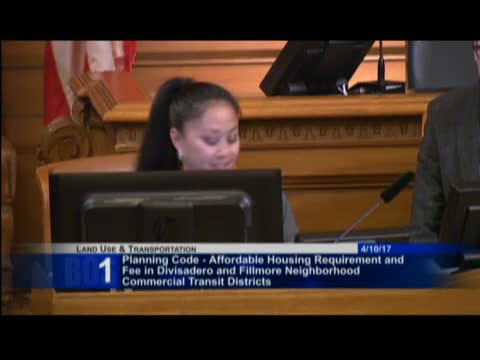
Land Use Committee continues Divisidero/Fillmore inclusionary-housing amendment after broad public comment
Summary
The Land Use Committee on April 10 continued an ordinance that would add affordable-housing requirements (or fees) for sites gaining development potential from the 2015 Divisidero and Fillmore rezonings; the continuance followed extensive public comment urging stronger low- and very-low-income requirements and community engagement.
The San Francisco Board of Supervisors Land Use Committee on April 10 voted to continue an ordinance that would require additional affordable housing — or payment of a fee — for sites that received higher residential development potential after the 2015 rezoning of the Divisidero and Fillmore neighborhood commercial transit districts.
Acting Chair Aaron Peskin took a motion from Supervisor Katie Tang, seconded by Supervisor Jeff Sheehy, to continue the item; the motion was adopted without objection and the matter was scheduled to return to the committee in May. Michael Howerton, representing Supervisor London Breed’s office, had asked for the continuance to allow more time for outreach.
Why it matters: dozens of residents and housing advocates turned out to urge stronger requirements for low- and very-low-income households and more direct engagement from Supervisor Breed’s office and planning staff. Speakers argued that neighborhood-level policies must reflect local income realities and should add to — not reduce — the citywide inclusionary standard.
Multiple public commenters said the draft legislation risks favoring market-rate units and failing to protect renters. Dennis Moscofi, a longtime District 5 resident, said he supported the continuance because "the current legislation [is] unacceptable" and because the measure appeared to favor market-rate housing over low-income housing. Jennifer Feaver of the San Francisco Tenants Union said a local survey showed a Western Addition area median income near 54% and argued the proposal’s income levels do not reflect conditions on the ground.
Several speakers asked that any amendments be additive to the citywide standard set by Proposition C (June 2016). Richard Ivanhoe cited that Prop C established a 15% requirement for low and very-low income in the city and referenced a November 2016 Nexus study (packet materials) when urging stronger inclusionary ratios.
What the public requested: community groups — including Affordable Divis, Neighbors United, D5 Action, the Eviction Defense Collaborative and student representatives — asked for public forums, clearer neighborhood AMI (area median income) calculations, and assurances that proposed inclusionary rates would be higher than or supplementary to citywide policy. Several speakers said they had planned to testify and wanted Supervisor Breed to meet directly with affected constituencies before the next hearing.
Procedure and next steps: Supervisor Tang moved and Supervisor Sheehy seconded the continuance. The committee agreed to hear the item again in May and encouraged ongoing community meetings with the sponsor and planning staff during the interim. No formal amendments or votes on the substance of the ordinance were taken at this meeting.
Authorities and references: commenters cited Proposition C (June 2016) and a November 2016 Nexus study that appear in the committee packet; the planning-code amendment was described by the clerk as an amendment to the planning code tied to the Divisidero Street and Fillmore Street Neighborhood Commercial Transit District rezonings.
The committee’s action leaves the substantive policy questions — the inclusionary percentages and how neighborhood AMIs will be applied — unresolved until the next hearing.