Get Full Government Meeting Transcripts, Videos, & Alerts Forever!
Get email alerts on the Affordable Housing Inclusionary topic
No spam. Unsubscribe anytime.
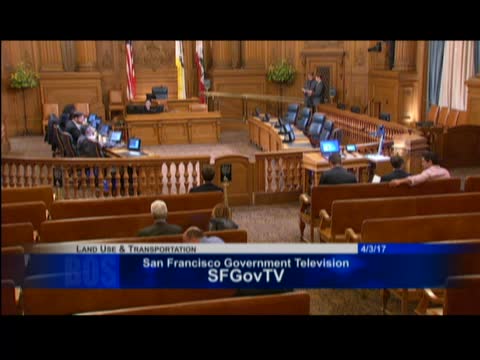
Land-use committee debates higher inclusionary requirements for Divisadero and Fillmore NCTs, votes one-week continuance
Summary
The San Francisco Board of Supervisors’ land-use committee on April 3 heard an ordinance from Supervisor London Breed that would require projects using new Divisadero and Fillmore NCT density decontrol to provide 23% on-site affordable housing (6% at 55% AMI, 8% at 120% AMI, 9% at 140% AMI) or 30% off-site; after extensive debate and public comment the committee continued the item one week for neighborhood AMI data and amendments.
SAN FRANCISCO — The Board of Supervisors’ Land Use and Transportation Committee on April 3 heard an ordinance from Supervisor London Breed that would raise inclusionary requirements for projects using recently created Divisadero and Fillmore neighborhood commercial transit (NCT) zoning. After hours of discussion and public comment, the committee voted to continue the item one week to allow staff to provide neighborhood-level area median income (AMI) data and to refine proposed amendments.
Breed, the ordinance’s sponsor, told the committee the measure is intended to “provide more homes for people along the Divisadero and Fillmore Street neighborhood commercial transit districts.” Under the draft ordinance, projects that take advantage of NCT density decontrol would be required to provide 23 percent on-site affordable housing or 30 percent off-site. Breed described the proposed on-site split as a three-tier mix: a minimum 6 percent of units for households earning up to 55 percent of AMI, 8 percent at up to 120 percent of AMI and 9 percent at up to 140 percent of AMI.
The sponsor said the mix was chosen to capture a broader range of working and middle-income households who do not qualify for existing subsidy programs. “If they are taking advantage of the NCT density decontrol provisions, this legislation will require pipeline projects to provide 23% on-site affordability or 30% off-site affordability,” Breed said.
Supervisors pressed the sponsor on policy trade-offs. Supervisor Aaron Peskin recited the history of Proposition C changes to city inclusionary policy and urged a citywide policy discussion rather than a district-by-district approach. He also suggested the sponsor consider the nexus study’s higher off-site fee level (33 percent) when weighing incentives to encourage on-site units. Supervisor Katie Tang asked staff and the sponsor to clarify how the ordinance would affect projects already in the entitlement pipeline.
Deputy City Attorney John Givner told the committee that whether future citywide higher inclusionary levels apply to these corridors is a policy choice for the board; he also advised that grandfathering and vesting rules can limit changes for projects that have already relied on prior rules. Planning staff cautioned that available AMI data does not map exactly to NCT boundaries and said more granular neighborhood estimates could take about a week to assemble.
Public commenters overwhelmingly urged changes or rejection of the current draft. Christian Einfeld, an attorney and member of Neighbors United, said he opposed the ordinance as written and called it a “giveaway to developers,” arguing new policy should not reduce protections for lower-income households. Dean Preston, a neighborhood resident and housing advocate, told the committee the draft “chops in half the housing for low income folks” and shifts benefits to households earning roughly $100,000–$150,000. Several speakers, including senior- and disability‑advocacy representatives, warned the proposal would not meet the needs of the city’s poorest residents.
Other speakers, including housing‑advocacy organizations, expressed support for creating more middle‑income housing while urging clarity and certainty so projects can secure financing. Todd David, representing the San Francisco Housing Action Coalition, said the city has not produced enough housing for middle‑income households and supported the intent while urging careful fiscal feasibility review.
With that mix of perspectives, Supervisor Tang moved to continue the item for one week so staff could assemble the requested neighborhood AMI data and the sponsor could refine amendments, including grandfathering language for pending projects. Supervisor Peskin seconded; the committee took the continuance “without objection.”
The continuance pauses formal amendments and gives planning staff time to provide more granular income data and for the sponsor to consider conforming changes to citywide inclusionary legislation. The committee did not make a final decision on the ordinance; the item will return to the committee after the one‑week continuance.
(Reporting: Chair Mark Farrell; Writer: London Breed presented the ordinance. Public commenters included Christian Einfeld, Jen (first name only), Renee Curran, Rufus Watkins, Norm Degelman, Shannon (first name only), David Wu, Laurie Lederman, Lisa Aubrey, Tony Robles, Calvin Mulch, Dean Preston, Todd David, Javier Vigil, Laura Clark, Quentin Mechkey, Tess Welborn.)