Get Full Government Meeting Transcripts, Videos, & Alerts Forever!
Get email alerts on the Ev Infrastructure topic
No spam. Unsubscribe anytime.
Committee advances EV-readiness rule with seismic retrofit exemption; ADU exemption fails in committee
Summary
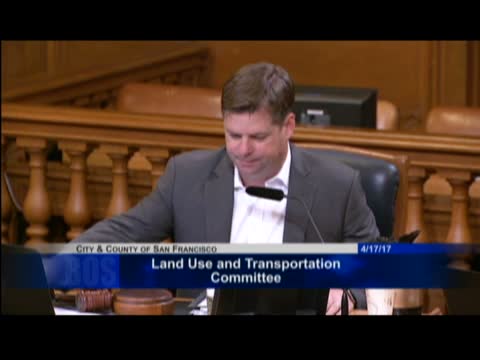
The Board of Supervisors Land Use & Transportation Committee voted to send an amended EV-readiness ordinance (which exempts mandatory seismic retrofit projects) to the full Board with a positive recommendation; a proposed amendment to exempt accessory dwelling units did not pass committee roll call.
The San Francisco Board of Supervisors Land Use & Transportation Committee on April 17 advanced local requirements for electric vehicle (EV) infrastructure in new buildings and major alterations, adopting a technical amendment that exempts projects carried out to meet the city’s mandatory seismic retrofit program.
Supervisor Katie Tang, sponsor of the EV-readiness ordinance, told the committee the Department of the Environment had met with stakeholders after last week’s hearing and is proposing a change on page 7, lines 6–8, to exempt seismic retrofit projects from the EV-readiness requirement. "We are proposing a change ... which essentially exempts projects that are undertaken specifically to meet the city's mandatory seismic retrofit program from our EV readiness ordinance," Tang said during the committee meeting.
Why it matters: Tang and Department of the Environment staff argued seismic retrofits are required by separate city programs and that complying with both rules simultaneously could impose undue burdens on retrofit projects. The committee action keeps the main EV-readiness requirements in place while carving out the seismic-retrofit exception.
Support, concerns and technical debate: Department of the Environment staff (Guillermo Rodriguez) said staff reviewed projects at the Department of Building Inspection and concluded the seismic exemption is appropriate; staff also told supervisors they reviewed ADU (accessory dwelling unit) questions and believed the ordinance’s thresholds would limit ADU impacts. Public commenters largely supported the ordinance: SPUR, ChargePoint, Tesla, 350 San Francisco and multiple housing and equity advocates urged the city to expand EV-charging readiness while noting trade-offs between housing and climate goals. Janine New of the San Francisco Apartment Association said her group had sought exemptions for both seismic retrofits and ADUs but recognized the department’s outreach.
A separate amendment to exempt ADU projects from the requirement, offered by Supervisor Aaron Peskin and referencing Planning Code section 207C, failed on roll call. The clerk recorded one 'aye' (Supervisor Peskin) and two 'no' votes (Supervisors Tang and Farrell); the committee recorded the amendment did not prevail.
Outcome and next steps: Supervisor Tang moved to send the EV-readiness ordinance, as amended (seismic exemption), to the full Board with a positive committee recommendation; the committee took that motion without objection and the item was forwarded to the Board of Supervisors for consideration.
The committee’s record shows strong private-sector and climate-group support for the general policy of making new construction "EV ready," coupled with continued attention to equity for renters and technical implementation questions. The Board will consider the ordinance on its April 25 agenda.