Get Full Government Meeting Transcripts, Videos, & Alerts Forever!
Get email alerts on the Healthcare Project Compliance topic
No spam. Unsubscribe anytime.
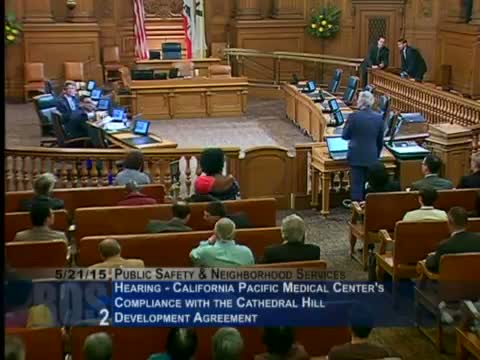
Supervisors hear mixed reports on CPMC compliance; city, community press for stronger monitoring
Summary
At a May 21 committee hearing, CPMC and city agencies reported overall compliance with portions of the Cathedral Hill development agreement but acknowledged gaps: a hiring shortfall in entry-level operations, a projected charity-care shortfall in 2014 addressed with 1,400 donated diagnostics, and planned peer review of language-access standards; community speakers urged a formal role in monitoring.
California Pacific Medical Center told a San Francisco Board of Supervisors committee on Thursday that it has met or exceeded many of the financial and workforce commitments in its 2013 Cathedral Hill development agreement, but city officials and community groups pressed the hospital for clearer enforcement after reporting several shortfalls.
"We're pleased to report that we've been found in compliance on all commitments by the city," Dr. Browner of CPMC told the Public Safety and Neighborhood Services Committee, reviewing the hospital system's 2013 report and noting construction progress and cash commitments to housing, transportation and public health. Browner announced partnerships with Northeast Medical Services (NEMS) and St. Anthony's Clinic and said the system expects two seismically safe hospitals at Van Ness and Geary to open in 2019.
City agencies and outside monitors supplied more-detailed, sometimes qualifying, numbers. Elizabeth Waddy of the Planning Department noted the DA became effective Aug. 10, 2013, and the 2013 compliance period covered about four and a half months; OEWD workforce analyst Greg Ise said the DA sets a 40 percent goal for entry-level operational hires through city referral systems but reported that, from project start through April 2015, just 45 of 159 entry-level hires (28 percent) were verified as system referrals, creating a hiring deficit of 19 positions that rolls forward under the agreement.
"For each hiring year the 40 percent goal applies; if they don't meet it, the deficit rolls over," Ise said, adding the hiring rate improved to 35 percent in the most recent hiring year but that CPMC remains accountable for the cumulative shortfall.
The Department of Public Health documented a likely shortfall against the DA's baseline charity-care commitment of 30,445 unduplicated Medi-Cal or charity patients per year. Colleen Chawla of DPH said that, to help make up the 2014 gap, CPMC agreed to provide 1,000 echocardiograms and 400 pulmonary function tests to San Francisco General Hospital patients who were on its waiting list, with DPH counting those donated diagnostic services toward CPMC's charity-care obligations.
"CPMC is providing these 1,400 diagnostic services with no reimbursement from the health department," Chawla said, and the work will be incorporated into CPMC's own charity-care reporting. DPH described the DA's two-year rolling- average remedy for shortfalls and said it will monitor whether the commitments are fulfilled.
DPH also raised questions about compliance with culturally and linguistically appropriate services (CLAS) standards at CPMC campuses, particularly at St. Luke's diabetes clinic after recent staff changes. Chawla said DPH proposed a two-level peer review (hospital-wide and clinic-specific) in March; CPMC has agreed to an internal review using outside consultants within 120 days and to share the consultant report and supporting data so DPH can conduct its own review.
Community groups and current and former staff filled much of the hearing's public-comment period. Speakers representing San Franciscans for Healthcare, Housing, Jobs and Justice and other coalitions called the monitoring process "ineffective" and urged a collateral agreement that would give community organizations a formal role in ongoing compliance oversight. Clinicians and community advocates said bilingual diabetes staff had been laid off at St. Luke's, potentially undermining care for Spanish-speaking patients; CPMC and DPH said bilingual services remain available but agreed to the peer-review process to resolve outstanding concerns.
CPMC executives defended recent changes and said the system has increased managed-care beneficiary enrollments and invested in local hiring and community programs. "We're actually hiring more San Franciscans than we get credit for because we only get credit for those who come through First Source," Dr. Browner said, adding that recent process improvements in referrals and hiring events should reduce the operational-hiring deficit.
City staff and supervisors pressed for continued transparency and monitoring: DPH said the NEMS/St. Anthony's partnership can enroll Tenderloin Medi-Cal beneficiaries beginning this summer and that clinics must remain open until the DA's 1,500-Tenderloin enrollment commitment is met. OEWD said it has increased reporting frequency (monthly vs. the DA's required six-month cycle) and holds regular meetings with CPMC and community-based organizations to troubleshoot referrals and hiring.
The committee ultimately filed the hearing record for placement on the Board agenda for June 2, 2015. Next steps identified at the hearing included CPMC's 120-day internal CLAS review with DPH follow-up, continued monthly reporting to OEWD, and community meetings planned for the summer around St. Luke's service mix and neighborhood concerns.