Get Full Government Meeting Transcripts, Videos, & Alerts Forever!
Get email alerts on the Digital Inclusion topic
No spam. Unsubscribe anytime.
Supervisors press city on closing digital divide as analysts recommend mix of infrastructure and programs
Summary
At a public hearing, the budget office outlined how 100,000+ San Franciscans lack home broadband; analysts recommended a mix of municipal fiber, dig‑once conduit policies, hardware subsidies, and training while the City CIO highlighted existing city fiber and SF Wi‑Fi.
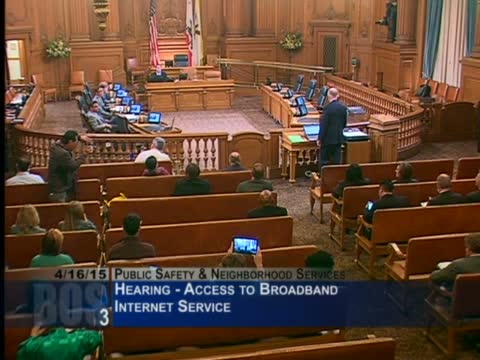
The Public Safety and Neighborhood Services Committee held a hearing April 16 on inequitable broadband access in San Francisco, hearing a report from the Budget and Legislative Analyst and testimony from city information‑technology leaders, community groups and local internet service providers.
Fred Brusso of the Budget and Legislative Analyst’s office said the city’s controller survey (2013) found 88 percent of respondents reported a home internet connection, but about 6 percent used dial‑up and roughly 12 percent reported no home connection — which the office estimated represents just over 100,000 San Franciscans without broadband as the term is commonly defined. Brusso stressed three persistent barriers: availability of wired service in some neighborhoods, affordability of monthly service and devices, and non‑adoption driven by lack of perceived need or skills.
His office outlined policy options including an annual digital‑divide survey, hardware subsidy programs, expanded training for seniors and youth, better utilization of the city’s City Fiber Network and SF Wi‑Fi, and a Dig Once ordinance to place conduit during street projects. Brusso cautioned municipal fiber to homes (the 'last mile') is costly and cited past estimates; he recommended pursuing lower‑cost steps while exploring larger infrastructure options.
Miguel Gamino, the city’s chief information officer, said the Department of Technology is expanding fiber to city facilities, connecting housing authority buildings and community centers, and improving SF Wi‑Fi. Gamino said the Connectivity Plan and a proposed Dig Once ordinance could reduce the cost of full fiber‑to‑the‑home builds by lowering the expense of placing conduit.
Supervisors pressed for numbers and an aggressive timeline: Supervisor David Campos called the plan 'timid' and asked for specific cost figures and targets; the budget analyst and CIO said some figures exist from earlier studies but that a range of financing and public‑private options remain under review.
Community speakers urged a comprehensive 'digital inclusion' approach that couples infrastructure with training, multilingual outreach and device subsidies. Local ISPs such as Monkey Brains and Webpass urged streamlined right‑of‑way and asset access to support competition and rapid last‑mile deployment. Comcast described its Internet Essentials program and said outreach restrictions limit enrollments, contributing to low take‑up among eligible families.
The committee asked staff to continue work on the city’s connectivity plan and to convene stakeholders; Chair Eric Marham and members said the hearing should be a first step toward a task force or formal follow‑up to set goals and funding strategies.