Get Full Government Meeting Transcripts, Videos, & Alerts Forever!
Get email alerts on the Calle24 Special Use District topic
No spam. Unsubscribe anytime.
Committee backs Calle 24 Special Use District to protect Mission’s Latino Cultural Corridor
Summary
The committee advanced a special use district for the Calle/20 Fourth Street Latino Cultural District that would cap new eating-and-drinking establishments at a 35% concentration threshold, require conditional use for certain storefront mergers and for businesses replacing legacy businesses, and exempt limited restaurants adding alcohol; recommendation forwarded to the full Board.
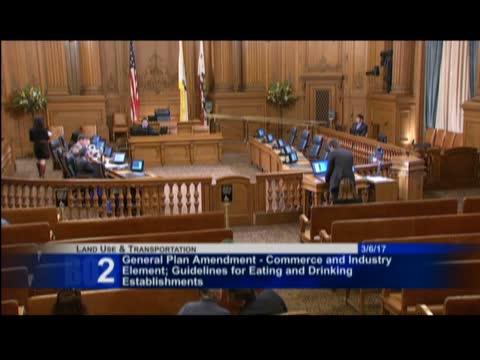
The Land Use & Transportation Committee on March 6 moved a proposed Calle 24 Special Use District (SUD) forward to the full Board of Supervisors with a positive recommendation as amended.
Supervisor Hilary Ronan, sponsor of the ordinance, told the committee the SUD is intended to protect the corridor’s cultural character and small locally owned businesses in the face of displacement pressures. "For the first time, we are using land use tools to articulate what characteristics we would like to see in new business coming into the neighborhood," Ronan said during her remarks.
Office of Economic and Workforce Development (OEWD) staff described the proposed district as limited to commercial properties along 20 Fourth Street and presented corridor data: roughly 182 storefronts between Bartlett and Potrero avenues; roughly 32% of storefronts are eating-and-drinking establishments and the area’s vacancy rate is about 11% (eight spaces actively available for lease, per OEWD presentation). OEWD said the SUD is one tool among many (including Invest in Neighborhoods programs and legacy-business support) and emphasized it is not intended to freeze change but to preserve key characteristics.
Key land-use controls included in the draft ordinance:
• A concentration prohibition for new eating-and-drinking establishments if adding a proposed business would push concentration above 35% within a 300-foot measure; existing restaurants would be grandfathered and certain limited restaurants seeking to add alcohol would be explicitly exempted (the committee adopted an amendment to clarify that exemption). • Conditional-use (CU) review would be required for storefront mergers at a much smaller storefront size threshold (staff cited lowering a previous 2,499-sq.-ft. merger threshold to approximately 799 sq. ft. to keep small storefronts protected). • CU review would also be required for businesses that propose to occupy storefronts previously held by legacy businesses unless the space has been vacant for three years.
Diego Sanchez of the Planning Department said the Planning Commission voted unanimously to favorably recommend the SUD and supported the staff amendment to exempt existing restaurants adding alcohol from concentration controls. He framed the SUD as a targeted tool to maintain 20 Fourth Street’s neighborhood-serving mix and pedestrian activity.
Community speakers were uniformly supportive at committee public comment. Gabriela Lozano, owner of Elle’s Cafe on 20 Fourth Street, told supervisors, “Without them, my business will disappear in a few years,” referring to legacy protections and the corridor supports. Moises Garcia, the corridor manager for the cultural district, noted the SUD is not a silver bullet but said it complements corridor management and legacy-business registry work.
Supervisor Katie Tang moved to send the ordinance to the full Board with a positive recommendation as amended; Supervisor Aaron Peskin seconded and the motion was taken without objection. The item will appear on the Board agenda for further consideration.