Get Full Government Meeting Transcripts, Videos, & Alerts Forever!
Get email alerts on the Mental Health topic
No spam. Unsubscribe anytime.
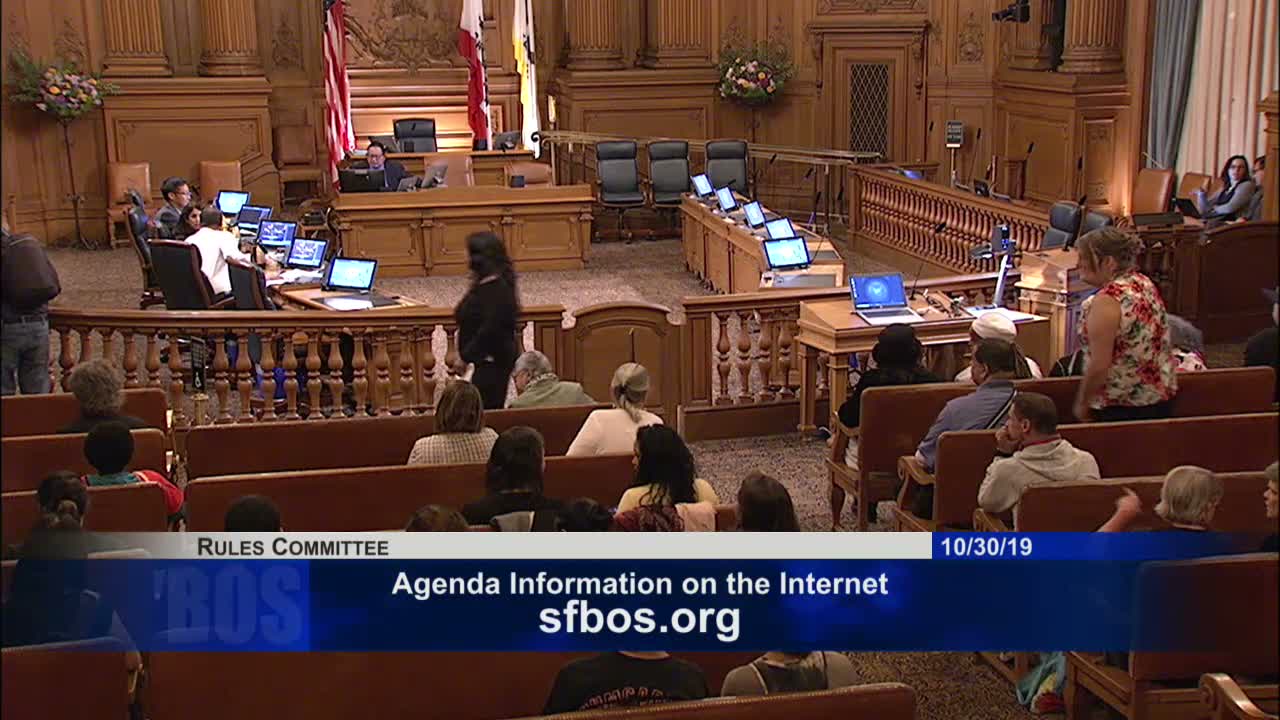
Rules Committee places 'Mental Health SF' on March 2020 ballot after hours of testimony
Summary
Supervisors Hillary Ronan and Matt Haney introduced Mental Health SF — a proposal to create universal mental‑health access — and the Rules Committee filed the measure for the March 2020 ballot after extensive public comment urging immediate action and oversight.
San Francisco’s Rules Committee on Oct. 30 introduced an ordinance called Mental Health SF and voted without objection to file the hearing and place the measure on the March 2020 ballot.
Supervisor Hillary Ronan, chair of the Rules Committee, described the proposal as a citywide system to provide low‑barrier, 24/7 access to mental‑health and substance‑use services, expanded case management tiers for people with differing needs, a drug sobering center, transportation supports and an Office of Private Insurance Accountability to help insured residents secure covered care. "We are finally moving forward," Ronan said, thanking frontline providers, unions and community advocates for hundreds of drafts that informed the measure.
Supervisor Matt Haney, a co‑sponsor, framed the effort as a structural reform to an emergency: "This is an issue of human rights," he said, urging coordinated data, accountability, and a shift away from police as the default first responders for psychiatric crises. Haney said housing must be part of the continuum of care and emphasized the need for clinicians trained to respond to psychiatric emergencies.
The hearing drew more than an hour of public testimony, almost entirely in support of the initiative. Speakers included clinicians, people with lived experience, union representatives and community advocates who described long waits for treatment, reductions in residential and acute capacity, and the harms of relying on law enforcement to respond to mental‑health crises.
"When someone seeks help and is put on a wait list, there's a very narrow window of time to make a difference," said Veronica Forbes, a community behavioral‑health specialist and former program manager of a Navigation Center. Curtis Bradford of the Treatment on Demand coalition appealed to supervisors to act quickly and not wait for the ballot: "People are dying now," he said.
Several commenters raised specific capacity concerns. Dale Milfey, a volunteer with the Northern California Commission on Psychiatric Resources, told the Committee that inpatient capacity had fallen from historically higher levels and urged that the measure include numbers and timelines for restoring acute, subacute and psychiatric emergency service (PES) beds. Those figures were presented as speaker claims during public comment and were not verified at the hearing.
Speakers also reported that two organizers, Sarah Short and Jenny Whirley, were arrested outside the chamber and barred from entering; a statement read on their behalf said treating mental‑health crises with arrest and incarceration is "cruel, ineffective, and costly." Committee members acknowledged the arrests and several speakers cited the incidents as evidence that the city’s response to mental distress requires overhaul.
The Rules Committee’s action was procedural: Chair Ronan said the measure was officially placed on the ballot and moved to "file" the hearing; the motion passed "without objection." Ronan and Haney also said they were negotiating with the mayor’s office and that, if a legislative compromise were reached before Nov. 27, the measure could be removed from the ballot and implemented legislatively.
The hearing record includes dozens of community organizations and labor endorsements cited by supervisors, including the Treatment on Demand coalition, NUHW (National Union of Healthcare Workers), AFT 2121, Community Housing Partnership, Tenderloin Neighborhood Development Corporation and the Mental Health Association of San Francisco.
What happens next: the measure is formally on the March 2020 ballot as of Oct. 30, 2019, but supervisors said they would continue discussions with the mayor’s office about whether to implement Mental Health SF legislatively instead of via a voter measure. The Rules Committee closed the hearing and adjourned.
Ending: The hearing record and the committee’s filing now become the basis for next steps from supervisors and will determine whether the proposal proceeds to a full board vote, is removed from the ballot if an agreement is reached, or remains before voters in March 2020.