Get Full Government Meeting Transcripts, Videos, & Alerts Forever!
Get email alerts on the Prop M Ballot Measure topic
No spam. Unsubscribe anytime.
Rules Committee hears mayoral initiative to change Proposition M office-allocation rules; opponents call it a 'poison pill'
Summary
The Rules Committee heard a March 2020 mayoral initiative to adjust Proposition M office allocations — expanding small-cap definitions, recapturing converted office space and creating an affordable housing/small-business priority reserve. Supporters said it accelerates housing-fee revenue; opponents called it a 'poison pill.'
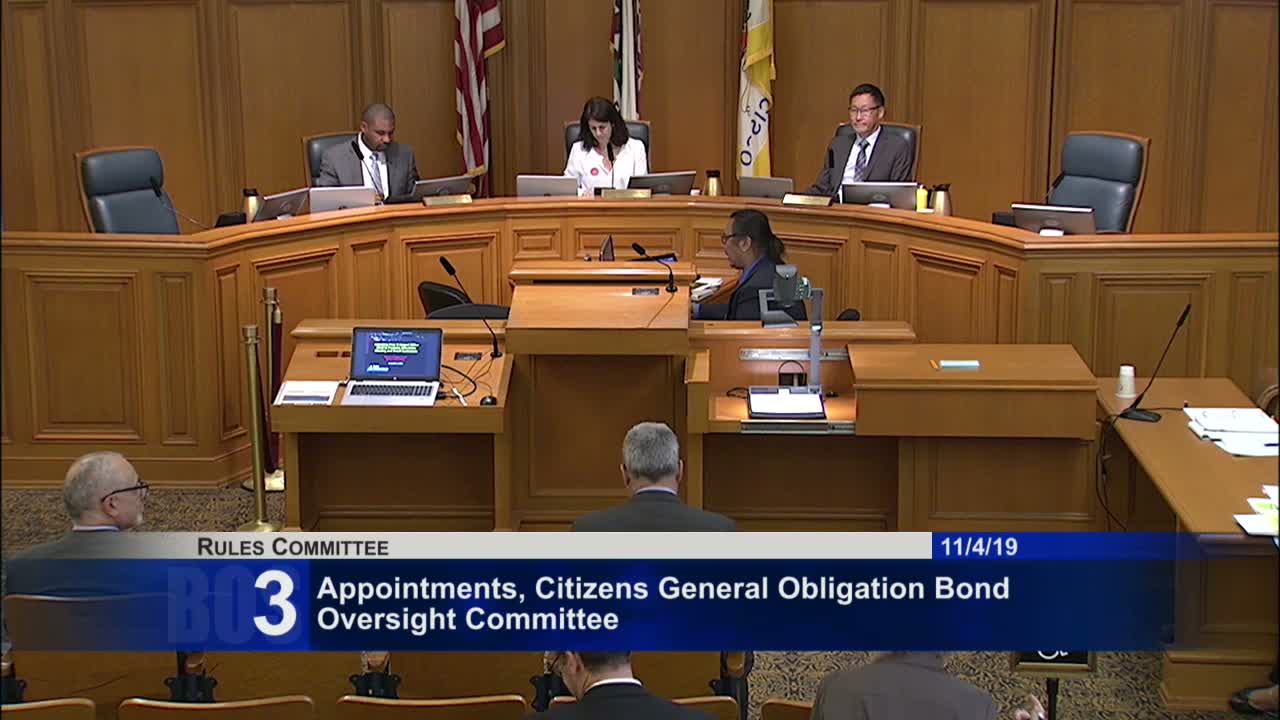
Supervisor Hillary Ronan’s Rules Committee on Nov. 4, 2019 heard a mayoral initiative that would change how Proposition M governs annual office allocations in order to open opportunities for affordable housing and small-business priorities.
Ken Rich, deputy from the Office of Economic and Workforce Development, told the committee the proposal responds to an unusual pipeline imbalance: "There are currently over 7,000,000 square feet of office development that are asking for approval in the pipeline, and only about 5,000,000 square feet projected over the next 5 years allocation available in that same period." He said the measure would (1) raise the small-cap threshold to 100,000 square feet, (2) permit office space legally converted or demolished since 1986 to be recaptured into a new priority reserve (estimates of lost space range from 1.4 million to 1.8 million square feet), and (3) create an affordable housing and small-business priority reserve from which projects that include specified community benefits could request allocations.
Why it matters: Rich argued the changes would accelerate projects and therefore accelerate jobs-housing linkage fee revenue that funds affordable housing and transportation. "You would get that additional 2,000,000 square feet times the jobs-housing linkage fee they owe you," he told supervisors, saying that could produce "many tens of millions of dollars" sooner for affordable housing.
What supporters said: Emily Abraham of the San Francisco Chamber of Commerce said the Chamber "supported jobs housing linkage fees" and backed the mayor’s measure as a way to keep small businesses and nonprofits in the city. Jay Chang, also with the Chamber, said the measure prioritizes allocations for mixed-use projects that include affordable housing, neighborhood retail or PDR (production, distribution, and repair) space.
What opponents said: John Darbeling and other opponents said the mayor’s initiative functions as a "poison pill" aimed at defeating a competing citizen-sponsored measure they described as the San Francisco Affordable Housing Jobs Balanced Development Act. Darbeling argued the mayor’s proposal does not guarantee enough affordable housing to meet the city's own nexus study estimates and said the measure’s recapture of 2,000,000 square feet would imply a need for roughly 1,400 additional affordable units that the ordinance does not provide for.
Questions from supervisors centered on whether the measure actually advances low- and moderate-income housing, whether features could be enacted legislatively, and how small a deeded parcel could be while still qualifying for the priority reserve. Rich said some changes (recapturing converted space) had been proposed as an ordinance and passed the Planning Commission, but that core changes like expanding the small-cap threshold to 100,000 square feet require voter approval. On minimum parcel size, Rich said the Planning Commission and the Mayor’s Office of Community Development (MOCD) have in practice rejected very small parcels (he cited 75–100 units as a de facto standard), but the ballot text itself does not include a prescriptive minimum.
Public comment reflected the split: community groups and neighborhood speakers — including representatives of the Coalition for San Francisco Neighborhoods, the Cultural Action Network and the East Mission Improvement Association — opposed the measure, warning it could accelerate gentrification and undermine affordable-housing goals. Supporters representing business and neighborhood interests said accelerating certain projects would generate infrastructure and housing-fee revenue and help retain small businesses.
Outcome and next steps: Supervisor Marr moved that "the hearing has been heard and filed," and the Committee took that motion without objection. The matter will proceed through the usual review and ballot schedule for the March 2020 election.
Authorities and references cited at the hearing included Proposition M (codified in Planning Code sections 3.20–3.25), the jobs-housing linkage fee change referenced by staff, and references by speakers to city nexus and Jobs-Housing Fit analyses.
The hearing transcript shows broad disagreement about whether the measure will produce the affordable housing its proponents say it will, and supervisors pressed staff on operational safeguards and minimums to ensure the priority reserve delivers meaningful housing outcomes.