Get Full Government Meeting Transcripts, Videos, & Alerts Forever!
Get email alerts on the Mta Budget Audit topic
No spam. Unsubscribe anytime.
Supervisors continue MTA budget amid audit questions and push to restore service cuts
Summary
The Board's Budget & Finance Committee continued consideration of the SFMTA budget to June 2 after extensive testimony on a recent management audit, disputes over distribution of the agency's May 18 response, and debate over how to roll back proposed 10% service cuts toward a 5% restoration using TA funds and labor concessions.
The San Francisco Board of Supervisors' Budget & Finance Committee on May 18 continued action on the Municipal Transportation Agency's budget after a lengthy hearing that mixed procedural disputes over a management-audit response with a substantive debate about service cuts, overtime and potential funding paths.
Chair Supervisor John Avalos opened the discussion after the budget analyst reported recommended PUC reductions. Supervisor Campos raised a procedural concern that a May 18 letter from the SFMTA executive director addressed to Board President David Chu had not been distributed to all supervisors; Budget Analyst Mr. Rose said his office had received the response late Tuesday and the distribution process was unclear. That exchange set the tone for the committee's review of the management audit and of the MTA's proposed operating budget.
SFMTA President Nolan (chair of the MTA board) told the committee the board welcomed outside review but pushed back on some audit comparisons and emphasized a committee-of-the-whole approach to governance. The board accepted the need for more governance training and to codify procedures, Nolan said, but resisted creating many new standing committees.
Budget analyst Mr. Rose flagged inconsistencies between the written response and oral testimony—pointing to a written line agreeing to form an audit committee that Nolan later described differently in the hearing. Mr. Rose said the analyst office would supply a written reply to the MTA's submission.
Supervisors focused most intently on the financial and operational implications of a proposed 10% service reduction by the MTA. MTA management, represented by Executive Director Nat Ford and staff, said the agency had shifted roughly 120 operators to capital projects (notably the St. Francis Circle work) and planned to absorb another ~50 positions through attrition; they estimated restoring 5% of service for the full year would cost roughly $14 million (about $11–$12 million as a partial-year sum).
Ford said labor negotiations with Transport Workers Union (TWU) remain central: the MTA has options on the table from earlier tentative agreements totaling about $14.4 million in potential concessions, but there was no guaranteed timeline for a membership vote. He also said about $10 million in non‑TWU labor concessions were close to final. Ford described workforce adjustments and controller-audit work-order recommendations as further levers to trim costs.
President David Chu and several supervisors framed a pathway combining a County Transportation Authority (TA) allocation and labor concessions: the TA and MTC funding discussions could supply roughly $7 million in targeted dollars, which paired with concessions from TWU might allow the MTA to reduce the 10% proposed cut nearer to 5% of service. Supervisors signaled support for a short continuance to test whether that combination could be finalized.
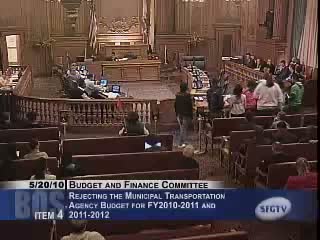
Supervisor McRamey moved to continue consideration of Item 4 (the motion to consider rejection of the MTA budget) to June 2; the chair took the motion without objection. The committee also agreed that Items 1 and 2 (city appropriations and the salary ordinance) be continued to the call of the chair.
What happens next: the committee left the item open so city staff, the MTA and labor can press for an agreement in the coming weeks. The committee directed staff to provide more detailed workforce, overtime and work-order numbers in writing and scheduled a closed-session planning item focused on labor negotiations. If negotiations do not produce a firm plan by the continuance date, supervisors signaled they would consider rejecting the budget at the full board.
Quotes: “We transport around 700,000 people every single day,” SFMTA board members said in defense of their record; “these cuts are disproportionately affecting low‑income riders, seniors and youth,” public advocates warned."