Get Full Government Meeting Transcripts, Videos, & Alerts Forever!
Get email alerts on the Transportation Demand Management topic
No spam. Unsubscribe anytime.
Supervisors continue citywide Transportation Demand Management ordinance to Dec. 5 after broad presentations and stakeholder requests for revisions
Summary
The Board committee advanced discussion of a proposed citywide Transportation Demand Management ordinance designed to reduce vehicle miles traveled from new development, but voted to continue the item to Dec. 5 so staff and supervisors can refine exemptions, fees and phasing language and consider additional amendments.
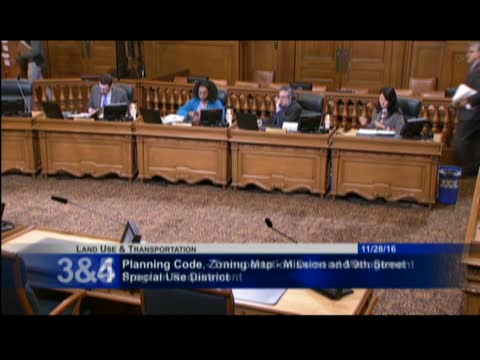
San Francisco — The Land Use and Transportation Committee on Nov. 28 advanced but did not finalize a citywide Transportation Demand Management (TDM) ordinance that would require many new development projects to adopt measures reducing vehicle miles traveled (VMT). The committee voted unanimously to continue deliberations to Dec. 5 so planning staff and supervisors can work with stakeholders on technical amendments, exemptions and a phased implementation schedule.
Supervisor John Avalos, the ordinance’s author, described the measure as the “shift” component of the city’s Transportation Sustainability Program. Avalos said the proposal would move the city away from measuring auto delays and toward reducing VMT by “having developers do their fair share” through on-site measures and incentives that encourage transit, walking and bicycling. He told the committee he planned to offer a package of amendments addressing health-and-human-services nonprofits, grandfathering for in‑pipeline projects, and other clarifications.
SFMTA Vice Chair Cheryl Brinkman and planning staff presented the technical framework. "This ordinance is data-driven, and it's informed by the latest research and the best practices," Brinkman said, urging committee support. Planning’s Corey Teague explained how the program would set point-based targets for projects based primarily on the amount of on-site parking proposed: "Simply speaking, the more parking that is proposed for the project, the higher the target." Projects would choose from a menu of up to 66 measures — from bike parking and showers to transit subsidies — each assigned points based on expected effectiveness.
Teague said the ordinance would apply to new residential projects that create 10 or more dwelling units (with an exclusion for 100 percent affordable housing), new nonresidential construction over 10,000 square feet, and changes of use over 25,000 square feet. Staff emphasized monitoring and enforcement: projects would be inspected before certificate of occupancy and required to submit implementation reports annually for five years (then every three years if compliant). Teague said the department has budgeted staff for proactive monitoring and proposed annual reporting fees (currently proposed at $1,000) to support that work.
Public-health, advocacy and development groups generally expressed support but urged changes. Megan Weir of the Department of Public Health said TDM could yield important air-quality and safety benefits; Walk San Francisco requested stronger walking-oriented measures and argued the ordinance should cover all parking, including non-accessory garages. Developers and small-site representatives urged program flexibility for modest projects and asked whether unit-based targets should account for bedroom counts.
Staff said they built flexibility into the menu and proposed lowering minimum target thresholds for small projects to reduce disproportionate burdens. On non-accessory parking, planning staff said the ordinance focuses on project-based, accessory parking but noted revisions to the standards to count some additional parking spaces where they functionally serve a project’s residents and risks of developers embedding garages to evade requirements.
Avalos outlined the amendments he would propose as part of an amendment-of-the-whole: findings tying household income to VMT reductions for affordable housing, a requirement that draft TDM plans be presented at pre-application community meetings, a phasing schedule (50% target for projects with applications on or before Sept. 4, 2016; 75% for applications between Sept. 5, 2016 and Dec. 31, 2017; 100% thereafter), and a clerical reporting change. Chair Supervisor Malia Cohen read planning’s recommended phasing language into the record and said the committee should allow time for stakeholder negotiations. The committee agreed and continued the item to Dec. 5.
Next steps: staff will work with sponsors and stakeholders to refine technical standards, draft the specific ordinance amendments Supervisor Avalos proposed, and return the item for further committee consideration on Dec. 5.