Get Full Government Meeting Transcripts, Videos, & Alerts Forever!
Get email alerts on the Juvenile Justice Reform topic
No spam. Unsubscribe anytime.
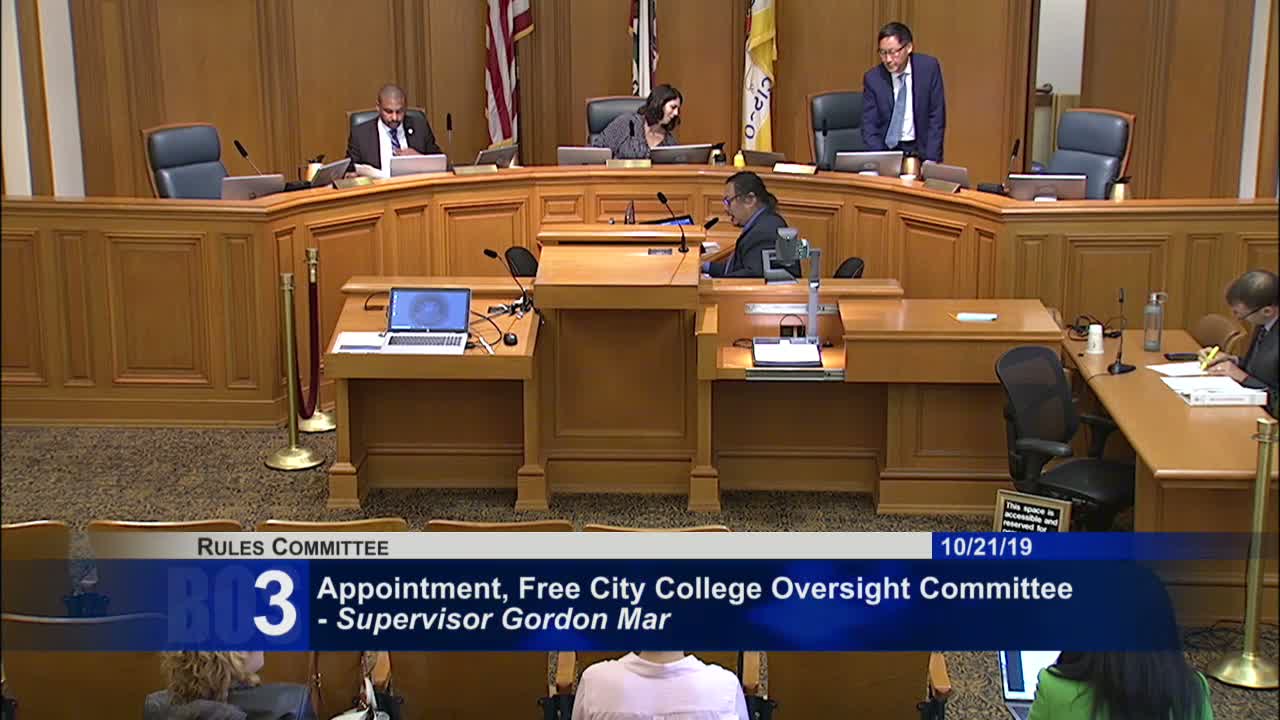
Rules Committee selects nine members to the Closed Juvenile Hall Working Group amid broad public testimony
Summary
Committee members and dozens of applicants and endorsers testified as the Rules Committee selected nine nominees to a 15‑member working group tasked with designing alternatives and overseeing closure of the city’s juvenile hall by December 2021. Speakers emphasized restorative approaches, overrepresentation of youth of color, and high per‑youth costs.
The Rules Committee spent a large portion of its Oct. 21 session hearing from applicants and community members before recommending nine nominees to the Closed Juvenile Hall Working Group, a panel charged with helping design alternatives to the city’s 150‑bed juvenile hall and implementing a planned closure by Dec. 2021. Committee members highlighted data showing a sharp long‑term decline in juvenile arrests and low facility utilization.
Chair Ronan and Supervisors Walton and Marr framed the working group’s charge with data: youth arrests have declined substantially over decades; in 2018 juvenile hall averaged only about 34 children in residence (leaving about 150 beds unused), and the committee cited an average annual operating cost per youth of roughly $280,000. Committee members and many presenters argued that detention is counterproductive, that rehabilitation and community‑based placements are more effective, and that racial disparities (the committee cited that Black youth were disproportionately represented among bookings) require centering affected communities and lived experience on the working group.
Applicants who presented included service providers, educators, parents, formerly incarcerated people, program managers and advocates. The committee heard testimony from a long list of candidates (examples: Nate Ford, Vicente Padilla, Christina Gomez via written statement, Ron Stuckel, Denise Coleman, Valentina Cedeno, Julia Thompson, Joanna Hernandez, Lonnie Holmes, Queen Vanessa Banks, Andrew Couples, Chris Lanier, and many others). Endorsements came from labor groups (San Francisco Labor Council, SEIU Local 1021, United Educators of San Francisco) and community organizations; union representatives urged appointment of candidates they had vetted for labor and parent‑seats.
Chair Walton moved to appoint nine people to the working group (Christina Gomez to seat 1; Valentina Cedeno to seat 2 with residency waiver; Joanna Hernandez seat 5 with waiver; Lonnie Holmes seat 6; Denise Coleman seat 7; Dan McAleer seat 8 with waiver; Constance Walker seat 9; Deborah Bill seat 10 with waiver; Samuel Carr seat 11 with waiver). The committee approved the motion without objection. The working group will proceed to develop alternative, community‑based models and recommendations in advance of the December 2021 target.