Get Full Government Meeting Transcripts, Videos, & Alerts Forever!
Get email alerts on the Housing Tenant Protections topic
No spam. Unsubscribe anytime.
Supervisors back amendments to create temporary housing preference for tenants displaced by renovation evictions
Summary
Supervisor Aaron Peskin proposed a temporary affordable‑housing preference for tenants temporarily displaced by capital‑improvement evictions; tenant advocates urged the change, the committee adopted Peskin’s technical amendments by unanimous consent and continued the item one week for a final tweak.
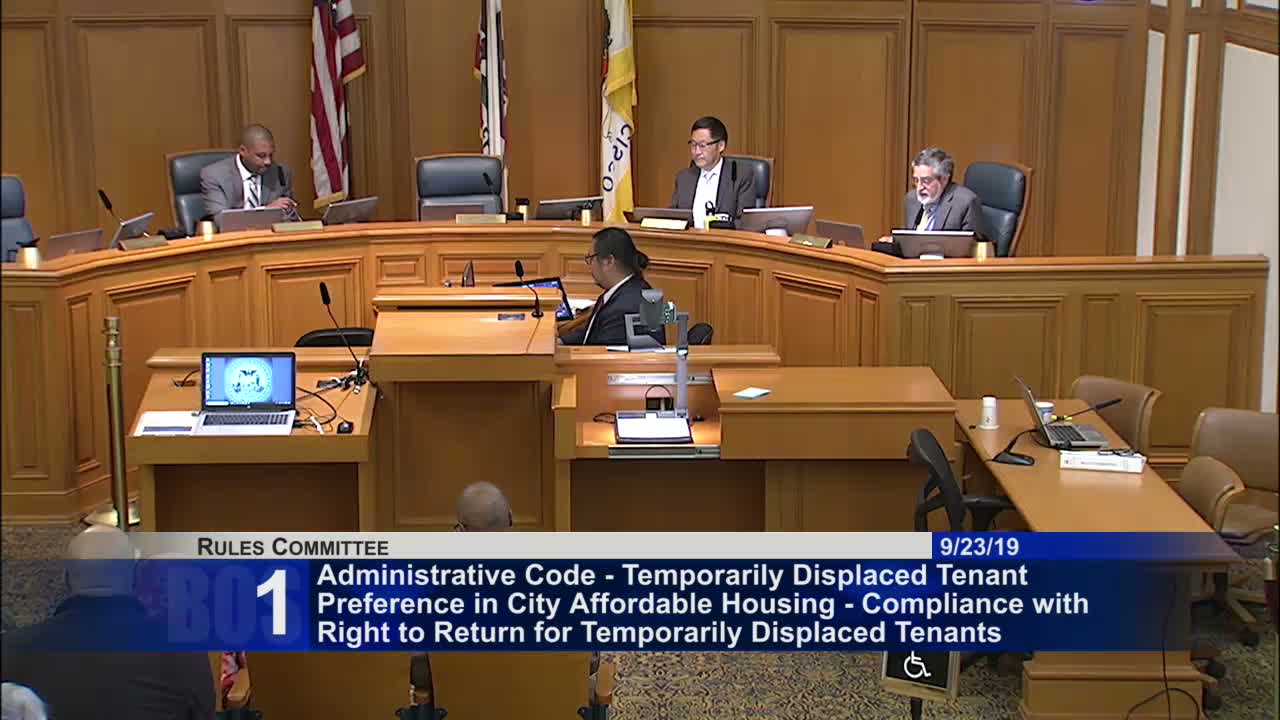
Supervisor Aaron Peskin introduced an ordinance to add a temporary preference in the city’s affordable‑housing programs for tenants displaced by temporary capital‑improvement evictions, saying the change would let affected tenants apply for housing without waiting years on existing lists. "This is a proposal to amend the city's existing affordable housing preference policy, to accommodate tenants, displaced by temporary capital improvement evictions," Peskin said during the Rules Committee hearing.
Peskin told the committee such temporary evictions are a citywide phenomenon concentrated in older rent‑controlled neighborhoods, and he cited a figure — "over 400 of them since 2017" — to underscore the scope of the issue. He proposed several amendments to the Administrative Code to clarify eligibility, require rent‑board forms for displaced tenants to keep contact information current, and direct administrative law judges to weigh landlord delay and tenant hardship when considering extensions beyond the three‑month default period.
Tenant advocates and legal aid groups uniformly supported the proposal during public comment. Shelby Nacino, a housing‑rights staff attorney at the Asian Law Caucus, said the preference would help monolingual, elderly and disabled households access safe, affordable temporary units and urged the committee to adopt the amendment that would require the rent board to consider tenant hardship in extension requests. "A landlord who seeks to displace an elderly tenant living on a fixed income should not be authorized carte blanche to spend an entire year doing unnecessary work," Nacino said.
Other speakers described long tenures and the practical barriers to temporary relocation: Marla Knight of the North Beach Tenants Committee recounted tenants forced to move to other cities away from jobs and medical supports; tenants from 819 Lombard described being ruled ineligible for certain assistance because their eviction was labeled temporary; and several senior tenants said relocation for many months would amount to homelessness for those on fixed incomes.
Committee members raised operational and legal questions. Supervisors asked how a temporary preference would be implemented without adding housing supply, whether conditional lease provisions could require tenants to return to their original units, and how the preference would interact with tax‑credit financing and Good Samaritan/Government‑funded projects. Peskin and housing‑sector representatives responded that the ordinance envisions a conditional occupancy—allowing tenants to occupy affordable units until the earlier of reoccupying their original unit or declining an offer within a specified period—and that the amendments include new findings an ALJ must consider when landlords seek extended vacancy periods.
Rent‑board and housing‑department staff warned implementation deserves more discussion. Amy Chan of the Mayor’s Office of Housing and Community Development said adding another preference would reduce units available to applicants without preferences and suggested folding the new category into existing displaced‑tenant preferences for easier implementation; she also said eviction‑preference rules must be reconciled with financing constraints on permanent affordable housing.
The committee requested more data about how many temporary eviction notices are extended past the three‑month standard; rent‑board staff said petition records are retrievable and agreed to provide relevant figures at the next hearing. The Rules Committee accepted Peskin’s offered amendments by unanimous voice consent and continued the item for one week so the supervisor could present one additional amendment and staff could prepare follow‑up information.
The committee's action does not by itself create a preference citywide; it moves the ordinance forward with the technical amendments and schedules further review of implementation details, including the data request on extensions and coordination with tax‑credit and project financing constraints.
The item was continued to the next Rules Committee meeting for an additional amendment and further implementation discussion.