Get Full Government Meeting Transcripts, Videos, & Alerts Forever!
Get email alerts on the Transportation topic
No spam. Unsubscribe anytime.
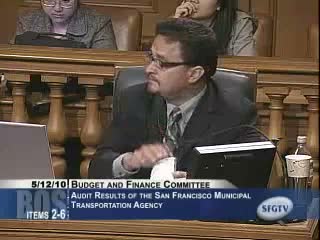
Budget analyst finds SFMTA governance and overtime problems as MTA defends cuts; supervisors weigh rejecting budget
Summary
A limited-scope audit by the Budget and Legislative Analyst accused the SFMTA of weak governance and elevated transit-operator overtime; MTA leaders accepted some recommendations but cited collective-bargaining constraints and defended recent service cuts and a two-year balanced budget that implements a 10% service reduction beginning May 8.
A limited-scope performance audit released to the Budget & Finance Committee concluded that the San Francisco Municipal Transportation Agency has not been operating as efficiently, effectively or economically as possible and contained four findings and 22 recommendations aimed at governance and overtime practices.
"Based on our audit findings, our conclusive determination is that the SFMTA has not been operating in the most efficient, effective, and economical manner," the budget analyst said in his presentation. The report singled out governance gaps (no formal audit committee, limited calendared review of audited financial statements, no comprehensive written governance principles) and operational drivers of cost such as high transit-operator overtime and scheduling practices.
On overtime, the analysts said the MTA accounts for roughly 44% of the city's total overtime and highlighted scheduling and staffing practices (long paid-standby periods and limits on part-time and short-duration "tripper" work) that increase paid time relative to driving time. The audit estimated at least $3,090,645 in potential annual salary savings if recommendations were implemented and flagged several operational practices that, the analysts say, permit paid overtime even when drivers have not worked a 40-hour week.
MTA leadership offered a mixed response. Board Chair Nolan (statement read by Executive Director Nat Ford) and Ford said they "generally concur" with many recommendations but pushed back on comparisons to larger stand-alone agencies and stressed the constraints of the agency's charter and the current collective-bargaining agreement. Ford acknowledged the need for further analysis and said the MTA would provide a comprehensive response by May 18. Brenda Walker (SFMTA) said further comparative work on scheduling, part-time use and cost analysis would be included in Part 2 of the MTA's response.
The audit and budget presentation occurred amid strong public comment: dozens of riders, seniors, tenant groups, labor and taxi drivers urged supervisors to reject the MTA budget and demand restored service. The MTA's two-year budget presented by Ford includes workforce reductions, deferred maintenance and a 10% service reduction implemented May 8; Ford said the board plans to consider possible ballot revenue options (vehicle-license fees, hotel tax, sales tax, expanded parking meter hours and related parking taxes) and will present options to the MTA board on May 18.
Why it matters: the audit targets governance and structural work rules that determine operating cost and service delivery. Supervisors signaled they may use their oversight powers, including a potential vote to reject the MTA budget, to press the agency on both governance reforms and service restorations.
What's next: the audit team will move into a second phase focused on operational issues and the MTA promised a detailed written response and further analysis on scheduling and overtime; the Budget & Finance Committee continued MTA budget items and will hear follow-ups, including the MTA's Part 2 response.