Get Full Government Meeting Transcripts, Videos, & Alerts Forever!
Get email alerts on the WISIP Workforce topic
No spam. Unsubscribe anytime.
PUC hearing exposes low San Francisco hire rates on $4.6B water program; supervisors press for stronger PLA/FirstSource enforcement
Summary
A lengthy May 11 hearing revealed San Francisco placements on regional WISIP projects are about 11% and local projects about 15%; supervisors and community speakers pressed SFPUC and OEWD to strengthen enforcement of First Source policies, amend the Project Labor Agreement (PLA) and improve apprenticeship pipelines.
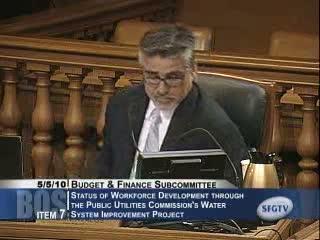
Supervisors, SFPUC officials and dozens of community members on May 11 engaged in a multihour hearing on the workforce and local‑hire performance of the San Francisco Public Utilities Commission—s Water System Improvement Program (WISIP), a $4.6 billion, multi‑county program.
Harlan Kelly, assistant general manager at the SFPUC, told the Budget & Finance Subcommittee that construction (to date) is about 17 percent complete and that the program breaks down into finance costs (~$500 million), project delivery (~$1.1 billion) and hard construction, with local construction about $400 million and regional construction about $2.6 billion. Kelly said material costs dominate heavy civil work (about 70 percent) and estimated the labor share is roughly $800 million across the program.
Kelly said early PUC data show San Francisco residents account for about 11 percent of placement hours on regional projects and about 15 percent on local projects. "Are we happy with these numbers?" Kelly asked, then answered, "No." He said the PUC is coordinating with the Office of Economic and Workforce Development (OEWD) and community partners to improve placements.
Supervisors focused on how the city—s First Source hiring policy, the Project Labor Agreement (PLA) and local hiring halls interact with regional projects and whether the 2007 legal interpretation that limited a straight 50 percent mandate for regional work constrains local hiring. Kelly and Rhonda (OEWD—s Director of Workforce Development) described practical constraints: heavy‑civil trades (notably tunneling) lack apprenticeship pipelines, many contractors bring core out‑of‑state crews, and the existing PLA and hiring rules rely largely on "good faith" efforts rather than firm quotas in the regional context.
Community members, union representatives and training program participants urged stronger enforcement and rapid fixes. Speakers called the PUC—s 11 percent figure "unacceptable," urged reopening or amending the PLA to add enforceable local‑hire mechanisms, and requested an audit and stronger monitoring on job sites. Labor representatives cautioned that some specialized trades require long training and that increasing apprenticeship access is critical.
Carol Eisen, who oversees PLA administration, said the PLA is a tripartite, living agreement among the city, unions and contractors; it includes a jobs‑and‑training framework and project‑level job plans. Eisen said administrative changes can be made relatively quickly but formal amendments to the PLA would be substantial and will require discussions with parties and the SFPUC commission. She promised the PUC would reconvene partners, propose administrative improvements and report back.
Supervisors asked for trade‑by‑trade apprenticeship data, a clearer enforcement plan, and options for legislative changes if administrative revisions prove insufficient. The committee voted to file the hearing record and directed follow‑up between the PUC, OEWD and supervisors.
What to watch next: Supervisors requested PUC and OEWD provide detailed apprenticeship and placement data by craft and project, propose administrative PLA changes, and return with recommended next steps — including potential legislation — to strengthen local hire outcomes.