Get Full Government Meeting Transcripts, Videos, & Alerts Forever!
Get email alerts on the City Finance topic
No spam. Unsubscribe anytime.
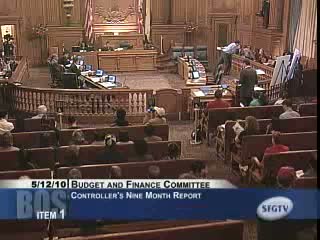
City controller: nine-month report shows modest improvement but $35M revenue gap remains
Summary
Controller Ben Rosenfield told the Budget & Finance Committee the city is roughly $35 million below budgeted general-fund revenues at the nine-month mark but has secured about $24.7 million in additional operating savings and one-time property-tax and transfer-tax gains that partly offset the shortfall.
The city controller told the Board of Supervisors' Budget and Finance Committee that San Francisco remains about $35 million below its budgeted general-fund revenue at the nine-month point in the fiscal year, but that department spending reductions and one-time property-related receipts have narrowed the gap.
"We remain about $35,000,000 below the budgeted level for revenue in the current fiscal year," Ben Rosenfield, city controller, said in presenting the third-quarter report. He said departments are projecting roughly $24,700,000 in additional operating savings following midyear spending reductions.
Rosenfield said revenue variances are mixed. The assessor's office cleared supplemental property tax bills that produced a one-time $25 million boost to the general fund this year, and property transfer tax collections have improved, with particularly strong receipts in the upper transaction bracket. "As of today, we have now exceeded the budget for the full fiscal year for property transfer tax," he said. Offsetting that, payroll tax receipts are down about 13% year to date and hotel-tax receipts have weakened versus earlier expectations.
The controller flagged department-level variations. Several departments are running short of resources late in the fiscal year, including elections, fire, the city attorney's office, juvenile probation and the sheriff's office; at the same time, other departments are reporting savings that increase the net ending balance available to help balance next year's budget. Rosenfield said roughly $4.7 million of a specified general-fund reserve had been spent, leaving about $20.1 million in additional ending balance available for the coming fiscal year.
Rosenfield and committee members discussed particular items that affect the city's baseline transfers: he estimated roughly $1.9 million of additional baseline transfer to the Municipal Transportation Agency (MTA) and smaller sums to the library and children's funds as a result of stronger property-related receipts. He also warned that some current-year gains—for example, higher transfer-tax dollars driven in part by distressed commercial sales—could depress property-tax bases in future years.
Why it matters: the nine-month accounting snapshot guides supervisors' choices ahead of budget adoption. The report gives lawmakers granular detail about where revenue shortfalls and one-time gains lie and points to budget decisions—spending reductions, reserve use and transfers—that will shape the next fiscal year.
What's next: the committee will take the controller's report into the record and continue deliberations on enterprise budgets, including the MTA, as the city finalizes its two-year budget timetable.